Wednesday, 17 August 2011

Mountain scrambling skills training course in The Lake District. Langdale, August 15th & 19th 2011.


Next on the list of August work for Iain after his Open Canoe Foundation Course was a scrambling skills training course in The lake District for deputy headmaster Chris Owen who lives near Manchester.

Chris has been getting out on a number of grade one scrambles recently with a couple of mates. However, he felt that things were getting to the point where to progress; and keep each other safe, it was time to get some proper tuition in the techniques of scrambling ropework.

Chris found our website when browsing scrambling courses in The Lake District and liked what he saw. He contacted Iain expressing an interest in booking on to a scrambling skills training course with us.

Unfortunately, Chris could only attend the course on his own as non of his scrambling mates were able to join him, so Iain arranged a bespoke one on one scrambling skills training course for Chris which was just what he wanted.

During day one, we started off looking at the technique of "spotting" ie helping each other up & down easy scrambling ground by the means of holding feet in place on insecure foot placements or just by giving each other a push up or holding on to folks as they climb down a steep bit. Basic stuff - but new to Chris. We then followed this by getting the rope out and tying on/taking chest coils (photo one) and the technique of short roping ie moving together on easy scrambling ground.


The easy scrambling ground we used was the lower left hand rib of Tarn Crag in Langdale - just above stickle (Mill) Gill. This is a great place to learn scrambling techniques on what is only a bit of grade one scrambling ground.

If it all goes wrong, you won't slip far on here, but there are enough rocky bits to look at all aspsects of basic scrambling including spotting, short roping and basic anchors and belays.

In photo two Chris heads up an easy rock step before looking for; and finding a place to securely belay Iain up to him. The ground was such that Iain could follow Chris without concern and then evaluate which ever method Chris had chosen to belay him with. It was a good way for Chris to learn what belay techniques were appropriate and what were inappropriate for the various situations we found ourselves in.


Iain showed Chris the three main methods of belaying ie protecting your second with a tight rope whilst they climb something where it would be deemed that " the consequences of a slip could turn into something more serious".

In photo three Chris employs a direct belay - using the rope around a solid rock spike in such a way that the friction of the rope on rock provides the protection. The twist in the rope in Chris's hand also provides improved grip on the "dead rope" side of the belay. This method can be used either for belaying a scrambler up or lowering back down; and whilst on the lower part of Tarn Crag, we looked at methods for both ascent and descent.

We also looked at indirect or body belays - where you bring a person up (or down) a slope merely by wrapping the rope around your body and bracing with your feet. This technique must only be used for belaying people on easy parts of a scramble! Later, whilst on some grade two ground, we would look at the technique of semi-direct belays ie tying in to the anchor and belaying from the rope tie in loop on your harness with a belay plate. Does this all sound complicated? The pictures from this day are annotated with explanations as to what can be seen and why the particular technique is being used - have a look!

Anyway, after our morning learning techniques on easy ground, Iain took Chris up The Spur (grade two) on Tarn Crag to demonstrate how one would look after seconds on this sort of ground. He then allowed Chris lead the same route and gave Chris feedback on the techniques he used during his ascent of the route as the leader.

We were meant to use the next day (Tuesday) as a consolidation day with an intention to move across the valley to Piked Howe - a fine little grade two scramble. However, heavy rain the next morning made scrambling anywhere an unsavoury and unsafe proposition, so we rearranged the day for later in the week when the weather was better.

In photo four, Chris gets to grips with anchor placements on the first buttress of Piked Howe. Iain allowed Chris to lead the entire route and during this time Chris's confidence on rock improved greatly as did his belaying skills and his selection of appropriate belays for the scrambling ground we were on

On Friday, we put a scrambling ascent of Piked Howe behind us by 1pm so we had time to nip back over to Tarn Crag to have a go at East Rib - another fine grade two scramble; and photo five shows Chris leading off up the first pitch.

Chris led the three harder pitches of The East Rib with confidence and efficiency - placing running belays where appropriate and using good belaying techniques to look after his second.

Iain feels that Chris now has the skills to progress on to grade two scrambling terrain with confidence and hopes that he doesn't hang around doing so. Our scrambling skills training courses in the Lake District make for great and safe learning experiences and you'll get a lot from a course with us - however, with regards to what you learn on the course, if you don't get out and practise soon after - you'll quickly lose those skills!


To discuss your requirements for a scrambling skills training course contact Iain at Kendal Mountaineering Services here. We are one of the Lake Districts premier providers of Scrambling Skills Training courses, Rock Climbing Skills Training courses and Navigation Skills training courses and we also offer winter skills and winter climbing courses too. We pride ourselves on teaching you the right techniques to go off in to the mountains and do things for yourselves, or if you fancy being guided up that classic Lake District scramble or rock route or even up a winter climb, give us a call!

We also run two annual guided trips to the Isle of Skye to do the Cuillin Ridge traverse. One in May and one in September each year. These include seven nights self catering accommodation and four days of guided scrambling on the famous Cuillin Ridge. These packages represent fantastic value for money and are a must for competent scramblers. The next one is May 2012 and will be running between the 19th & 26th. Cost £425 for the week.

5 day Open Canoe skills training course in The Lake District August 8th - 12th 2011.

During August 8th - 12th, Iain from Kendal Mountaineering Services worked for the Cadet Centre for adventurous training (CCAT) running an Open Canoe Foundation course in The Lake District.

The CCAT Open Canoe Foundation Course (OFC) is designed to give young people the basic skills required to handle these craft on open water ie lakes. Depending on how well people progress during one of these OFC courses, they may well be entitled to gain their BCU 1 or 2 star awards.

The first photo shows Iain's team of four on day two on Coniston Water - looking somewhat wet, but rightly pleased with themselves as having capsized both craft in the picture and all gone in themselves they had just successfully completed an "all in rescue". In this, they had to empty out first one canoe and get two people back in - and then empty out the other canoe and get its paddlers back in. This was done fairly rapidly - well done team!

We had a total of five days together during our Canadian Canoeing course in The Lake District. We spent Monday at Waterhead on Windermere looking firstly at flat and then moving water skills.

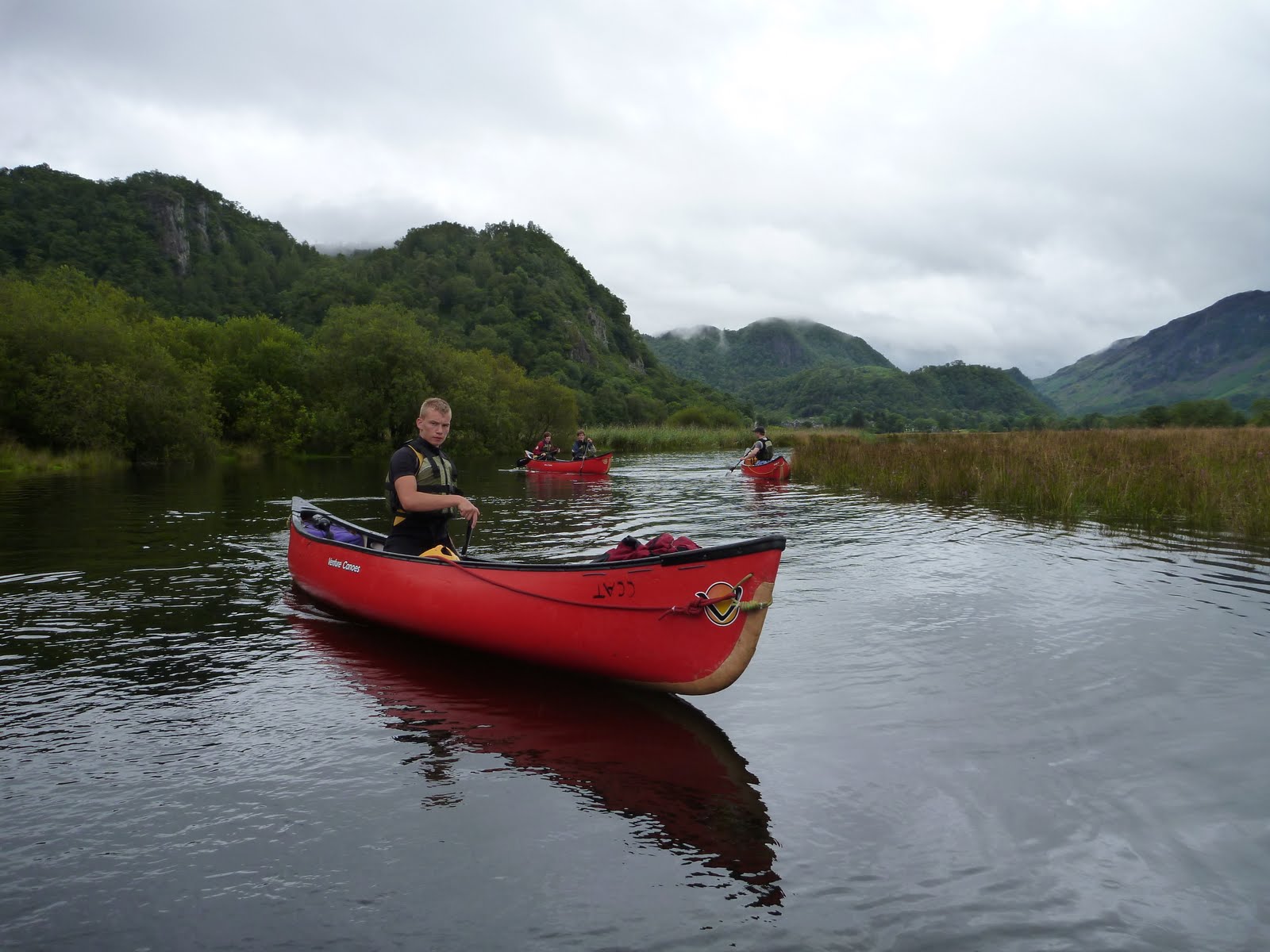
Tuesday was on Coniston Water looking at more advanced skills and Wednesday (photo two) we headed to Derwentwater to join up with the three star group intending a paddle down Derwentwater followed by a descent of the middle Derwent.

The plan on day three would have been fine had we chosen not to paddle Derwentwater first. As we got to our access point, a strong wind started to blow NE. The weather was already poor with low cloud and sheets of rain drifting across the lake and having set off for the north end of Derwentwater. We soon found ourselves being blown before a strong wind. Canadian canoes have a great deal of their surface area above water and so are badly affected by wind. It was difficult, if not virtually impossible to paddle on Derwentwater, so we had to leave the lake and portage the canoes to a suitable place where they could be collected with a canoe trailer - did we get to the river? Not on this day!

On Thursday, the winds had dropped. We still had low cloud and a chance of rain, but it was looking more settled, so Iain chose to return to Derwentwater once again - this time to look at moving water skills on the upper Derwent which flows from Borrowdale in to Derwentwater.

This was possible because three of Iain's party were already very competent paddlers - having already undertaken their Kayak Foundation Course (KFC) with CCAT some time previously and they had, on Monday, spent some time solo paddling their canadian canoes.

So, on the Thursday, we looked again at solo and tandem paddling in Canadian canoes and also moving water techniques such as breaking in to and out of eddies, ferry gliding, poling, reading the river and arranging ourselves to take the best line down easy rapids. The upper Derwent was a safe and friendly place to do this.

Photo three was taken on the upper Derwent and shows Alex getting the hang of forward ferry gliding - leaning the boat slightly downstream, having the correct angle of boat across the current and paddling on the downstream side using as few strokes as possible - great job!

The final photo is a view along the upper Derwent looking south in to Borrowdale as we returned downriver to Derwentwater. Adam, nearest in his canadian canoe, is paddling solo and was busy practising the Indian Stroke which is an advanced technique.

All of the cadets on this OFC thoroughly enjoyed themselves and learnt a great deal from Iain during the week.

Whilst the Open Canoe Foundation Course is a fairly advanced level course, you too can arrange your own open canoe skills training courses with Iain from Kendal Mountaineering Services. Open Canoeing is a great session for families, groups or individuals and can be either a half day taster session or a full day or multi-day activity here on the Lake Districts many lakes & rivers. It is also great as part of a teambuilding course and is popular with stag & hen parties visiting the area and looking for something different to do.

To book your open canoeing course with Kendal Mountaineering services contact us here. To see the rest of the pictures from this five day Open Canoe Foundation Course click here.


Sunday, 7 August 2011

Double Ghyll Scrambling & Canyoning session. Church Beck, Coniston. Saturday 6th July 2011.

Kendal Mountaineering Services has had a busy day in Church Beck at Coniston today.

Two separate groups joined Iain & Scott in the ghyll today. Firstly, GEN II - one of our new corporate clients, brought ten delegates to the ghyll this morning. (Photos 1 & 2)

The ghyll scrambling & canyoning sessions we organise for GEN II are part of an induction weekend where successful applicants to the Nucleargraduates Programme come together for the first time to learn about the two year apprenticeship programme they will be joining.

Our ghyll scrambling & canyoning sessions are seen as being fun and a challenge for these people, however, the session is designed as an icebreaker and an opportunity for the group members to get to know each other.

It is also designed as a whole team activity in so much that all members are expected to work together and help and support each other throughout the session. This will help to set the scene for the next two years where these people will be expected to get along with, work and support each other as they progress through their two year apprenticeship before leaving to join positions in the nuclear industry.

The apprentices enjoyed their ghyll scrambling & canyoning session with us and we wish them well with their apprenticeships. Thank you GEN II coming back to us once more and we look forward to working with you again soon. Further photographs from GEN II's morning session with us can be viewed here.


By contrast, the afternoon ghyll scrambling & canyoning session in Church Beck (photos 3 & 4) were a bunch of mates out for a jolly! Michelle Howarth from South Lakes, booked the session for herself and 14 of her friends from the gym.


The group were staying in Coniston for the weekend, so didn't have far to come to meet us for the one oclock start. They were a real bunch of characters who were looking forward to a fun wet session in the ghyll and Iain & Scott made sure that they got exactly that.


Conditions in the ghyll in the afternoon were busy, with a number of competitors also working with groups. Also, the weather finally broke although it had been overcast all day and considerably cooler than the previous day.


Photography in the ghyll was difficult due to the dark & wet conditions leading to a lack of good shots during the canyoning descent parts of todays sessions in Church Beck, but the wetness was all part of the fun for the group who, of course, got absolutely soaked and thoroughly enjoyed the whole experience. The rest of the photos from their session can be viewed here.


We were only one of a number of local adventure pursuits company that Michelle contacted with her enquiry and we got the business - thank you Michelle, not only for that, but also for being a great group to work with and we hope to see you all again. To book your ghyll scrambling or canyoning session with Kendal Mountaineering services contact us here. We enjoy providing your sessions and skills training courses as much as we hope you enjoy yourselves doing them and we never disappoint.


Tuesday, 2 August 2011

Ghyll scrambling half day session. Wren Gill, Longsleddale, The Lake District. Saturday July 30th 2011.


It has been a busy week here at Kendal Mountaineering services. Firstly with regards to running the Giggleswick Summer School outdoor activity programme followed by a multi-pitch climbing teaching day.

Iain rounded off the week with a stag party who had booked a half day ghyll scrambling session as part of their stag event here in The Lake district.

The lads were up for their stag weekend all the way from Birmingham and were staying in the Kendal area. Richard Davies, who had booked the ghyll scrambling session with Iain had been on the ball by booking with us several months ago, so, things were well organised.


Rather than taking the lads all the way over to Church Beck, Iain met the party in Kendal and took them up Longsleddale to go to Wren Gill - as it was more convenient and just as good a time can be had there as at any other ghyll scrambling venue here in the Lake District national park.

The weather all last week was hot and sunny, so hot in fact that after the walk up to the venue from the parking area, we were all very glad to get in to the water and cool off. The first photo shows the group having just gotten in to Wren Gill and the second shows the stag - Fraser, cooling off in a waterfall - respendent in pink bathing cap under his helmet, pink goggles and armbands - the things mates do to each other on a stag event!!


We made our way up the gill to the amusement of other onlookers - who probably wondered what it was all about as an army of wetsuit clad blokes made their way upstream wearing bouyancy aids and helmets - all standard issue kit on a ghyll scrambling session with Kendal Mountaineering services.

Photo three shows the team entering the first really deep pool in Wren Gill. Having swum it, many people went back in a second & third time - having jumped in from the rocks on the left of the pool.

Continuing on from here, eventually, the gorge deepens & narrows before we reach a deep pool with an unclimbable waterfall beyond. Here, we had to exit the gorge and continue several hundred metres up the bank before we could climb down and continue up the bed of the gill to the final waterfall.


The final photo shows the whole group having a power shower under the top fall in Wren Gill.

The Stag party throughly enjoyed their ghyll scrambling session in The Lake District National Park with Iain from Kendal Mountaineering services. We would like to wish Fraser all the best for his wedding and in the future also.

Other photographs taken during this session can be viewed here. To book your ghyll scrambling session in The Lake District National Park with Kendal Mountaineering services contact us here and remember -wherever you are staying, we will have a venue for this fab activity near to you!

Multi-pitch Rock Multi-pitch Rock Climbing skills training day. Langdale, July 29th 2011.


After Iain's four days with the Giggleswick Summer School programme, he was straight back out again the next day, on rock, with private client, Chris Jackson.

Chris is a keen climber - when he has a chance to get away from his position as a lecturer in London! He has previously climbed on the Derbyshire gritstone edges and claimed to be able to climb up to E2.

It was clear that he had good rock climbing ability but he felt that he wanted to improve his knowledge of climbing rope work and in particular, focus on building belays at stances and stance management for multi-pitch climbing.

With this in mind, Iain decided to take him to Upper Scout Crag in Langdale where Routes One & Two would allow us ample opportunity to look at these areas for development. Photo one shows Chris climbing the crux pitch of Route One which is a fine multi-pitch VDiff+ rock climb.


Iain decided that the best way for chris to get some idea of how to rig anchors at stances and build safe and equalised belays would be for Iain to lead the first multi-pitch rock climb and show Chris the various ways of tying in to anchors and stance management.

Photo two shows the method of equalising anchor points to a single attachment point using slings.

Three "wires" have been placed in to cracks in the rock and connected to dyneema slings with screwgate karabiners. The "wire" anchors have been brought to a central attachment point (the karabiner in the foreground) by knotting the slings with simple overhand knots in the appropriate positions allowing all three anchors to be equally loaded in the event of a shock load.

The lead climber will have attached themself to the central attachment point using a clove hitch on the rope attached to them. Having gotten themselves in an appropriate position on the stance, the climber would now shout "safe" to the second who would know to take them off belay.

The above system of equalising anchors and bringing them to a central attachment point, will normally be used when one climber or instructor is guiding another person ie leading all rock climbing pitches and leaving the second at the stance each time


In photo three, Iain demonstrates the method generally used by "trad" climbers when each person is alternately "leading through" on a multi-pitch climb.

The lead climber will, once reaching a stance, set up a minimum of two anchors (three or more if any of the others are considered marginal placements) and then connect to all of them using the climbing rope. The best way to do this is to run the rope through each anchor krab individually and then return it back to the rope tie in loop on the climbers harness. Two methods can be used for tying the rope back to the rope tie in loop - either rethreaded figure of eight knots on the bight (a bight being a loop of rope) or, as Iain has done in this photo, clipping the rope in to a single HMS karabiner using a clove hitch.

This is a simple belay system - useful for setting up quickly and then being easily adjustable for equalisation purposes - particularly where the anchor points are out of reach of the climber. Its main drawback is that one cannot easily escape the system should the leader need to get help or rescue the second. However, if you come on one of our improvised rescue skills courses, we will show you all that you need to know in order to be able to deal with any scenario encountered in a multi-pitch rock climbing situation.


So, with Iain having lead Route one and Chris having observed the different methods of setting up a belay at stances, it was then time for Chris to have a go.

The final photo shows Chris at the third stance on route two having set up an elaborate, but safe belay system with which to protect Iain. Chris is also demonstrating good rope management technique by draping the dead rope over his attachment - this is better than having lying it all over the stance and possibly falling back down the pitch below - leading to all sorts of potential problems.

Chris's ropework techniques improved significantly as a result of his one day multi-pitch climbing workshop with Iain in The Lake district. All he needs to do now is get out and practice the skills learnt. Kendal Mountaineering Services run a number of skills training courses here in the Lake District apart from Rock Climbing Skills Training courses. We also run Navigation Skills Training courses, scrambling skills training courses; and if you join us in Scotland in winter, you can attend one of our Winter Skills courses or our winter climbing courses. Contact us for more information.

Giggleswick Summer school. Outdoor Adventure Programme. July 25th - 28th 2011


Last week, Iain from Kendal Mountaineering services ran a programme of adventurous activities for the Giggleswick School Summer school programme.

Giggleswick School is an independent boarding school based in the Yorkshire Dales National Park near settle and the Summer School programme is run for potential pupils and existing boarders, but is primarily designed to give a taste of what the school has to offer potential clients.

For the Outdoor Adventure programme, Iain and his assistant - Richard, had two groups each day, a morning group consisting of 12 pupils and and afternoon group consisting of ten young people. The first photo shows the morning group on day one whilst on our way up Penyghent - one of the famous Yorkshire Dales Three Peaks, during our hillwalking day.


On the second day, Iain & Richard ran a beginners rock climbing and abseiling session for each group at "Hostel Rocks" a gritstone climbing venue - actually within the school grounds at Giggleswick.

The venue is a single pitch crag no more than 8m high along its 150m length and has many trees growing along the top making it ideal for a simple top rope/bottom belay session. Iain was able to set up four top ropes for the group and everyone had a go at climbing and towards the end, abseiling.

Photo two shows one pupil enjoying a climb whilst another group work together in the background - whilst one pupil climbs, another three belay using the "bellringing" technique involving only an HMS karabiner, an Italian Hitch; and lots of hands on the rope.

This simple technique is ideal for young people trying an introductory rock climbing session and is good for getting everyone working together.


Day three saw us gorge walking at South Barkin Gill at Barbondale near Kirkby Lonsdale. Gorge walking, also known as ghyll scrambling or gorge scrambling is an outdoor activity generally involving walking, climbing and swimming up a wet stream bed. However, at Barkin Gill, the stream bed is limestone and all of the water sinks away making it a generally dry ghyll scrambling trip.

In photo three, Iain's assistant - Richard "spots" one of our party as he climbs up one of the easier pitches in South Barkin Gill. Above this point, the pitches get bigger and steeper necessitating the use of a rope to protect climbers.

There are few venues in the Yorkshire Dales National Park for good ghyll scrambling so, if you really want to do this come to The Lake District where the streams are bigger and the pools are deeper! Check out our blog and website for details of the best venues and our recent ghyll scrambling trips.


Finally, on Iain's last day with the Giggleswick Summer School adventurous activities programe, he & Richard took both groups to the great introductory caving venues of Runscar & Thistle caves at Ribblehead in The Yorkshire Dales National Park. Photo four is taken in Runscar Cave.

These two cave systems are ideal for introductory caving trips and are good even in wet weather. Both caves have larger main passages with a number of entrance & exit points and Thistle Cave has a number of smaller fossil oxbow passages that provide a real caving experience for anyone wishing to take up the challenge of crawling through them.

We had time during each session to take the pupils through both caves and gained the impression that out of the four activities offered over the four days, caving was the one that they enjoyed the most.

To book your outdoor activity session for your family over the Summer holidays here in The Lake District or in the Yorkshire Dales National Park, contact Iain at Kendal Mountaineering Services here.

Monday, 18 July 2011

Guided Cuillin Ridge Traverse. Isle of Skye. September 10th - 17th 2011.

Kendal Mountaineering Services is offering the opportunity to partake in one of our bi-annual guided Cuillin Ridge traverse trips taking place between Saturday 10th and Saturday 17th September 2011.

The Cuillin Ridge is over 12km long and has twenty two summits along its length of which 11 gain Munro status.

The Cuillin Ridge traverse is one of the finest and longest rock climbing & scrambling routes in Europe with over 4000m (13'000 feet) of ascent & descent. The entire ridge is a scramblers & mountaineers paradise largely being composed of grade one ground, but with some grade two, three & four ground as well as rock climbing to severe standard and a number of abseils to undertake en route.

Iain Gallagher from Kendal Mountaineering services
has been running annual guided Cuillin Ridge Traverses since 2006. He has completed some 12 traverses of the Cuillin Ridge altogether; and has successfully guided seven parties along this supurb mountaineering challenge - the most recent being during May 2011.

For £375 the package we offer you includes 7 nights self catering accommodation in our comfortable cottage near Carbost on the Isle of Skye plus the opportunity of four days of guiding on the Cuillin Ridge Traverse making this an unbeatable opportunity to take part in a traverse of The Ridge.

Iain, a Mountaineering Instructor, has, considerable experience of guiding on the Cuillin Ridge. A successful complete traverse is dependant on good weather conditions and whilst we cannot guarantee your successfully completing the whole traverse, our plan of tackling sections of the ridge over four days out of six means that you will have a great experience and every opportunity of completing a significant part, if not all of the Cuillin Ridge Traverse.

Unlike many packages on offer with regards to the Cuillin Ridge Traverse, Iain prefers to keep the itinery totally flexible. Depending on conditions and wind direction - we may go to opposite ends of the ridge from one day to the next; or if the weather is bad, we will take a rest day when party members can go and check out all that the rest of the Isle of Skye has to offer.

Each day on the ridge will see us aim to depart the cottage by 08:30 or earlier if the weather dictates and arrive back at the cottage by early evening to enjoy a meal cooked by others and a well earned rest in a comfortable bed.

Iain will work with up to six people during our guided Cullin Ridge traverse. As a member of the guided party it is expected that you are already an experienced mountaineer with some experience of scrambling and ropework and comfortable with a degree of exposure which is present on a number of sections of the ridge.

You will also need to be fit and healthy for what is a strenuous and demanding challenge and you must also be prepared to work as part of a team - all working together to help Iain make the possibility of a successful traverse reality.


Whilst at the cottage, everyone attending is expected to provide one communal evening meal for all other members of the team during our stay. Breakfasts and packed lunches are your own responsibility.


Regarding equipment - you will need to bring your own foul weather equipment, a rucksac of at least 45 litres and a stout pair of walking boots with a good cleated (Vibram type) sole and good ankle support. Approach shoes are wholly unacceptable for the ground encountered on the Cuillin Ridge.


Helmets & harnesses can be provided by us for a small fee.


There are many exciting parts to a guided Cuillin Ridge Traverse with Kendal Mountaineering services - The famous Thearlaich Dubh Gap, The Inaccessable Pinnacle, the airey traverse of the summits of Sgurr A Greadaidh and Sgurr A Mhadaidh, the ascent of Am Bastier and the West Ridge of Sguur Nan Gillean. Some or all of the objectives will be achieved as part of your guided Cuillin Ridge Traverse.


Whatever we manage to acheive during the Kendal Mountaineering Services guided Cuillin Ridge traverse, you will have a great experience in this breathtaking environment with a guide who knows the ridge extremely well.


To read reports from previous trips go to the Kendal Mountaineering Services Blog where reports from May 2009, 2010 & 2011 can be found along with a report from our trip in September 2010.


To book your place contact us here or call Iain on 07761 483364