Our final post from August 2014 concerns one of our corporate clients - Nucleargraduates.
Nucleargraduates have been using our services since 2011 to provide Ghyll Scrambling as a means to facilitate a development in relationships between groups of graduate apprentices who have individually, been successful in securing a sponsored apprenticeship within the Nucleargraduates 2 year Apprentice Programme.
The group seen here is the final intake for the 2014 cohort.
Nucleargraduates came to us initially looking for an activity which would impell these successful graduates into working together and getting to know each other better.
Everyone in this group had come together for the first time, the previous evening in Kendal. All of them will be working together ( often in pairs for the same sponsor organisation) as they move around those various sponsor organisations over the next two years.
Impelling them all together in a ghyll Scrambling Session has proven to be successful as a way in which to get them to work together more comfortably and helps to set the scene for the next two years
So what do we do? We provide the setting for the session to take place and make sure that all of these young people are properly equipped for that session.
Ghyll Scrambling must seem like quite a daunting activity for any person to try of their own accord - "Get into a freezing cold stream & walk up it? What"! But actually, it can be a lot of fun!
After a safety briefing, our instructors will largely let the group get on with it - only stepping in if safety becomes questionable or they consider that the group could, in some way, be working better together. Photo three shows the sort of outcome that both we & our client want to see - a happy, well bonded team. looking after each other and getting to know each other better!
The final photograph sees a rare view of Iain doing his job on the biggest waterfall Stickle Ghyll has to offer.
The graduates are roped up this one at a time - encouraged by Iain from above who keeps them on a tight rope whilst they climb; and by the support of their peers - waiting to take their turn at the bottom.
At this stage in the day, the weather had turned windy and there was nearly as much water being blown back up the waterfall as was falling down it!
All of this particular intake of graduate apprentices thoroughly enjoyed their session and had "gelled" together as a group much better - as Iain could see that evening when he was very kindly invited to enjoy a meal and share a social occasion with them in Kendal.
We would like to take this opportunity to wish all of the 2014 cohort every success with their apprenticeships and beyond and would like to thank Nucleargraduates for their continued custom.
If you would like a corporate Team Building Event arranging and designed against specific objectives for your business then contact us to arrange a bespoke event for you. You'll be surprised at what we can offer!
Wednesday, 3 September 2014
Half Day Ghyll Scrambling Sessions in The Lake District National Park. August 28th 2014.
Today was the final instalment of Nick & Freya's three days of adventures in The Lake District with Iain & Kendal Mountaineering Services.
It is great to be so well qualified that we can offer many different activities to suit everyone's tastes and we one of the few Lake District businesses to be able to offer such variety. Unfortuately though, we don't offer Sailing, Windsurfing or Mountain Biking Courses. Iain believes that a good instructor should be passionate about the sports they instruct in and in his case that doesn't apply to the three outlined above!
So, today saw Iain, Nick & Freya in Stickle Ghyll in Langdale enjoying a Ghyll Scrambling Session in The Lake District.
What is Ghyll Scrambling? Well, quite frankly - one of the most popular activities we offer! The word "Ghyll" is a northern phrase meaning a mountain stream or ravine. Gorge Walking is another term for the same activity and it generally means - getting into a stream, walking upstream, wading & swiming through pools such as here in photo two; and climbing up waterfalls - roped up where necessary.
Above all, Ghyll Scrambling/Gorge Walking is meant to be FUN! Undoubtedly, it is best done on a warm day but we will do our utmost to ensure your comfort & protection by equipping you with wetsuits, walking boots, cagoules, buoyancy aids (where necessary) and helmets & harnesses. All of this equipment costs around £270 per person to provide and you should make sure you get all of it when booking a Ghyll Scrambling Session with any provider. We charge £45 per person for a half day(4 hour) session and there is no doubt that you'll find other providers in the area offering you the same session for less - allegedly! - but they will be cutting corners somewhere; and most likely with the provison of your safety equipment. It's worth bearing in mind!
The final photo from this post sees Nick & Freya at the foot of the biggest waterfall climb in Stickle Ghyll.
To get to this point, we had already covered approximately 1500 metres of gorge, swimming, climbing & scrambling; and once again, the weather had been kind to us.
We climbed this waterfall with Iain's GoPro Camera taking some fine videos of the pair climbing it, before continuing a little further upstream than the other group on the right in order to climb one last waterfall.
We think that Nick & Freya enjoyed their three days of adventures in The Lake District and the Yorkshire Dales with us but you'll have to wait to see what they said about it. Amongst other things, they have been provided with a collection of photographs and GoPro Videos taken by Iain throughout the 3 days which, along with all of the equipment provided during their sessions; were included in the price. We do wonder how many of our competitors offer you so much for your money??
If you would like to arrange your own bespoke Outdoor Activity Package Holiday in The Lake District then contact us. In all of our sessions -We specialise in giving you what you want!
It is great to be so well qualified that we can offer many different activities to suit everyone's tastes and we one of the few Lake District businesses to be able to offer such variety. Unfortuately though, we don't offer Sailing, Windsurfing or Mountain Biking Courses. Iain believes that a good instructor should be passionate about the sports they instruct in and in his case that doesn't apply to the three outlined above!
So, today saw Iain, Nick & Freya in Stickle Ghyll in Langdale enjoying a Ghyll Scrambling Session in The Lake District.
What is Ghyll Scrambling? Well, quite frankly - one of the most popular activities we offer! The word "Ghyll" is a northern phrase meaning a mountain stream or ravine. Gorge Walking is another term for the same activity and it generally means - getting into a stream, walking upstream, wading & swiming through pools such as here in photo two; and climbing up waterfalls - roped up where necessary.
Above all, Ghyll Scrambling/Gorge Walking is meant to be FUN! Undoubtedly, it is best done on a warm day but we will do our utmost to ensure your comfort & protection by equipping you with wetsuits, walking boots, cagoules, buoyancy aids (where necessary) and helmets & harnesses. All of this equipment costs around £270 per person to provide and you should make sure you get all of it when booking a Ghyll Scrambling Session with any provider. We charge £45 per person for a half day(4 hour) session and there is no doubt that you'll find other providers in the area offering you the same session for less - allegedly! - but they will be cutting corners somewhere; and most likely with the provison of your safety equipment. It's worth bearing in mind!
The final photo from this post sees Nick & Freya at the foot of the biggest waterfall climb in Stickle Ghyll.
To get to this point, we had already covered approximately 1500 metres of gorge, swimming, climbing & scrambling; and once again, the weather had been kind to us.
We climbed this waterfall with Iain's GoPro Camera taking some fine videos of the pair climbing it, before continuing a little further upstream than the other group on the right in order to climb one last waterfall.
We think that Nick & Freya enjoyed their three days of adventures in The Lake District and the Yorkshire Dales with us but you'll have to wait to see what they said about it. Amongst other things, they have been provided with a collection of photographs and GoPro Videos taken by Iain throughout the 3 days which, along with all of the equipment provided during their sessions; were included in the price. We do wonder how many of our competitors offer you so much for your money??
If you would like to arrange your own bespoke Outdoor Activity Package Holiday in The Lake District then contact us. In all of our sessions -We specialise in giving you what you want!
Introductory Caving Courses in Yorkshire Dales National Park. Wednesday 27th August 2014.
After our great day of Guided Climbing in The Lake District, Iain met Nick & Freya in the Yorkshire Dales National Park for an Introductory Caving Session in Long Churns.
The weather was as good as the previous day - as can be seen from this photo taken in Long Churns Lane. Hardly a cloud in the sky!
We met at Inglesport in Ingleton for breakfast before we started our caving session. Popping into this great outdoor shop with it's fantastic cafe has been a tradition of ours for many years - just as it is with many other caving groups heading to enjoy all that this beautiful area has to offer adventure-wise, underground.
Photo two sees Freya & Nick in the main streamway in Middle Long Churns.
We had entered the system at Middle entrance and explored a few fossil passageways along the way before arriving here.
It was good to find Long Churns Lane devoid of minibuses and other user groups when we arrived today. Long Churns Cave System is a fantastic introduction to caving in the Yorkshire Dales National Park, However, it is also very popular with Outdoor Centres from all over The Lake District and Yorkshire and when there are five or more 17 seat minibuses in Long Churns Lane, it is a place best avoided.
However, in that scenario, we know many other great caves to take you for your first caving experience. Have a read of The Blog from July and you will see what we mean!
Photo three sees Freya as she slid, easily, through The Cheese Press. This challenging squeeze through a bedding plane between two layers of limestone, is Long Churns most often remembered section - by children & adults alike.
The crawl is only about 4 metres long but involves moving through with your helmet on its side, wriggling through on your forearms & toes.
After doing this - anything else in Long Churns is easy. Well done Freya!
After visiting Lower Long Churns and The Cheese Press, all three of us made our way to the top of the Dolly Tubs Pitch into Alum Pot - the great 80 metre shaft hidden in the small wood passed en route to Long Churns. With our lights switched off, we could faintly see daylight coming in from the shaft beyond.
We continued around Long Churns, visiting the top of Diccan Pot in the process and then briefly appeared above surface at Diccan Entrance before taking the wet crawl back upstream into Middle Long Churns. We then did a tour of Cross Passage before returning to Middle Entrance - climbing the entrance waterfall before heading upstream to climb the waterslide at Doctor Bannisters's Washbasin at the end of Upper Long Churns.
In photo four, Nick is seen climbing the waterslide where Alum Pot Beck enters Upper Long Churns and the large pool of the Washbasin.
Our final photograph is taken on the Limestone pavement near the entrance to Upper Long Churns.
This bare limestone was scraped clear of any surface cover by the great glacial icefield that retreated northwards at the end of the last ice age - over 15'000 years ago. The surface of the rock is now a maze of channels created as acidic rainwater erodes the rock and looks really impressive.
All that remained to do now was to return to the vehicles, get changed; and head back to Inglesport for some cake and a brew; or in Nick & Freya's case - some lunch.
Nick paid just £45 per person for this half day Introductory Caving Session in the Yorkshire Dales National Park and all of the equipment you see the pair wearing was provided as part of the fee.
As we move into Autumn, Caving is a great activity to try out - sheltered underground no matter what the weather might be doing above and having a really adventurous experience as you explore passageways - not knowing what is around the next corner! But of course you will always be accompanied by one of our experienced Caver Leaders who will look after your safety.
Caving should be tried by everyone at least once! Contact us here to book your trip, we look forward to working with you.
The weather was as good as the previous day - as can be seen from this photo taken in Long Churns Lane. Hardly a cloud in the sky!
We met at Inglesport in Ingleton for breakfast before we started our caving session. Popping into this great outdoor shop with it's fantastic cafe has been a tradition of ours for many years - just as it is with many other caving groups heading to enjoy all that this beautiful area has to offer adventure-wise, underground.
Photo two sees Freya & Nick in the main streamway in Middle Long Churns.
We had entered the system at Middle entrance and explored a few fossil passageways along the way before arriving here.
It was good to find Long Churns Lane devoid of minibuses and other user groups when we arrived today. Long Churns Cave System is a fantastic introduction to caving in the Yorkshire Dales National Park, However, it is also very popular with Outdoor Centres from all over The Lake District and Yorkshire and when there are five or more 17 seat minibuses in Long Churns Lane, it is a place best avoided.
However, in that scenario, we know many other great caves to take you for your first caving experience. Have a read of The Blog from July and you will see what we mean!
Photo three sees Freya as she slid, easily, through The Cheese Press. This challenging squeeze through a bedding plane between two layers of limestone, is Long Churns most often remembered section - by children & adults alike.
The crawl is only about 4 metres long but involves moving through with your helmet on its side, wriggling through on your forearms & toes.
After doing this - anything else in Long Churns is easy. Well done Freya!
After visiting Lower Long Churns and The Cheese Press, all three of us made our way to the top of the Dolly Tubs Pitch into Alum Pot - the great 80 metre shaft hidden in the small wood passed en route to Long Churns. With our lights switched off, we could faintly see daylight coming in from the shaft beyond.
We continued around Long Churns, visiting the top of Diccan Pot in the process and then briefly appeared above surface at Diccan Entrance before taking the wet crawl back upstream into Middle Long Churns. We then did a tour of Cross Passage before returning to Middle Entrance - climbing the entrance waterfall before heading upstream to climb the waterslide at Doctor Bannisters's Washbasin at the end of Upper Long Churns.
In photo four, Nick is seen climbing the waterslide where Alum Pot Beck enters Upper Long Churns and the large pool of the Washbasin.
Our final photograph is taken on the Limestone pavement near the entrance to Upper Long Churns.
This bare limestone was scraped clear of any surface cover by the great glacial icefield that retreated northwards at the end of the last ice age - over 15'000 years ago. The surface of the rock is now a maze of channels created as acidic rainwater erodes the rock and looks really impressive.
All that remained to do now was to return to the vehicles, get changed; and head back to Inglesport for some cake and a brew; or in Nick & Freya's case - some lunch.
Nick paid just £45 per person for this half day Introductory Caving Session in the Yorkshire Dales National Park and all of the equipment you see the pair wearing was provided as part of the fee.
As we move into Autumn, Caving is a great activity to try out - sheltered underground no matter what the weather might be doing above and having a really adventurous experience as you explore passageways - not knowing what is around the next corner! But of course you will always be accompanied by one of our experienced Caver Leaders who will look after your safety.
Caving should be tried by everyone at least once! Contact us here to book your trip, we look forward to working with you.
Guided Rock Climbing Courses in The Lake District, Monday 26th August 2014.
Nick Sutcliffe contacted us in July looking for a 3 day Adventure Activity Holiday in The Lake District for himself & daughter Freya. You'll be able to read about the other activity sessions they booked in the other two posts.
This post is about the day of Guided Climbing in The Lake District that they booked with Iain.
Photo one sees Freya safeguarding her Dad as he climbs the crux moves on Route 1, Upper Scout Crag, in Langdale.
Even though the pair wanted to be guided on some multi-pitch rock climbing routes there is always some teaching to be done - generally in the principles of runner extraction. Once this skill was covered, we could begin to get on with rock climbing.
Iain would be leading all pitches of the several routes we climbed at upper Scout Crag, but he saw it as an ideal opportunity to teach the others some belaying skills and Freya was especially keen. There was also the system of climbing calls to learn as well.
We picked our first day out together for Rock climbing - as the forecast had indicated that this would be the best of the three days available to Freya & Nick. As you'll see in photo two - taken on the descent route, the weather really was perfect!
With such good weather, it was unlikely that we would be the only people to be climbing at Upper Scout Crag and were soon joined by several other pairs. Back at the base of the crag we could see another pair had followed us up Route 1 and others were just leaving the second stance on Route 2. Looking at this, a plan was forming in Iain's mind - had the pair every done an abseil retreat from a crag before? If not, it would be a useful skill to know!
Whilst Nick might well have done an abseil in his past climbing career, Freya had never abseiled and was keen to try it. So, we climbed the first two pitches of Route 2 to the Oak Tree and then prepared to abseil back down.
An abseil retreat involves escaping the system and then arranging the rope so that an abseil can be performed following with the rope being retrieved. Photo three sees Nick as he abseils back to Iain - if you want to know more about this skill - then book on to one of our Lake District Rock Climbing Skills Training Courses or Rescue Skills Training Courses for Climbers!
At this point, we had done five pitches of rock climbing and an abseil retreat - not bad going, but there was still another two and a half hours of the day left!
So, Iain's cunning plan to keep the pair occupied involved climbing the first pitch of Route 1 (our very first pitch of the day) followed by a variant called Route 1.5 which joined Route 2 just below it's overhanging crux.
Photo four sees Freya as she climbed the crux of Route 2 on her way to join Iain at the next stance. Once up, Freya was attached to the anchors by Iain before she belayed up her Dad.
This left one final pitch of Route 2 to climb in the sun - a great end to a fantastic day of guided Multi-pitch Climbing in The Lake District.
Our final photo from the day sees Nick & Freya looking back at Upper Scout Crag. The weather had been glorious through and although there had been a fair breeze blowing in the morning - at least it had been warm. In the afternoon the breeze had died away and it became quite hot, but not unpleasantly so.
Nick had paid £80 each for himself & Freya for this guided rock climbing day. The fee includes the provision of helmets, harnesses, ropes and climbing rack and guiding by an enthusiastic Mountaineering Instructor.
We had done eight pitches of rock climbing as well as abseil and the pair had a great day out. You can too when you book a Guided Rock Climbing Course in The Lake District with us. Contact us here to book your course today, we look forward to working with you!
This post is about the day of Guided Climbing in The Lake District that they booked with Iain.
Photo one sees Freya safeguarding her Dad as he climbs the crux moves on Route 1, Upper Scout Crag, in Langdale.
Even though the pair wanted to be guided on some multi-pitch rock climbing routes there is always some teaching to be done - generally in the principles of runner extraction. Once this skill was covered, we could begin to get on with rock climbing.
Iain would be leading all pitches of the several routes we climbed at upper Scout Crag, but he saw it as an ideal opportunity to teach the others some belaying skills and Freya was especially keen. There was also the system of climbing calls to learn as well.
We picked our first day out together for Rock climbing - as the forecast had indicated that this would be the best of the three days available to Freya & Nick. As you'll see in photo two - taken on the descent route, the weather really was perfect!
With such good weather, it was unlikely that we would be the only people to be climbing at Upper Scout Crag and were soon joined by several other pairs. Back at the base of the crag we could see another pair had followed us up Route 1 and others were just leaving the second stance on Route 2. Looking at this, a plan was forming in Iain's mind - had the pair every done an abseil retreat from a crag before? If not, it would be a useful skill to know!
Whilst Nick might well have done an abseil in his past climbing career, Freya had never abseiled and was keen to try it. So, we climbed the first two pitches of Route 2 to the Oak Tree and then prepared to abseil back down.
An abseil retreat involves escaping the system and then arranging the rope so that an abseil can be performed following with the rope being retrieved. Photo three sees Nick as he abseils back to Iain - if you want to know more about this skill - then book on to one of our Lake District Rock Climbing Skills Training Courses or Rescue Skills Training Courses for Climbers!
At this point, we had done five pitches of rock climbing and an abseil retreat - not bad going, but there was still another two and a half hours of the day left!
So, Iain's cunning plan to keep the pair occupied involved climbing the first pitch of Route 1 (our very first pitch of the day) followed by a variant called Route 1.5 which joined Route 2 just below it's overhanging crux.
Photo four sees Freya as she climbed the crux of Route 2 on her way to join Iain at the next stance. Once up, Freya was attached to the anchors by Iain before she belayed up her Dad.
This left one final pitch of Route 2 to climb in the sun - a great end to a fantastic day of guided Multi-pitch Climbing in The Lake District.
Our final photo from the day sees Nick & Freya looking back at Upper Scout Crag. The weather had been glorious through and although there had been a fair breeze blowing in the morning - at least it had been warm. In the afternoon the breeze had died away and it became quite hot, but not unpleasantly so.
Nick had paid £80 each for himself & Freya for this guided rock climbing day. The fee includes the provision of helmets, harnesses, ropes and climbing rack and guiding by an enthusiastic Mountaineering Instructor.
We had done eight pitches of rock climbing as well as abseil and the pair had a great day out. You can too when you book a Guided Rock Climbing Course in The Lake District with us. Contact us here to book your course today, we look forward to working with you!
Tuesday, 2 September 2014
Scrambling Skills Training Courses in The Lake District. Saturday & Sunday August 23rd & 24th 2014.
After the somewhat Autumnal feel to most of August, the weather, the weather improved significantly for Darren & Caroline Kells Scrambling Skills Training Course in The Lake District with us, the weekend before last.
After having been out on a few previous occasions with friends who had gotten into difficulties somewhat when attempting classic scrambling routes in the UK, both Darren & Caroline had decided that it was time to take some proper tuition in scrambling from a Mountaineering Instructor and had booked their course with Kendal Mountaineering Services way back in January.
Iain took the pair to Tarn Crag in Langdale where we spent the morning of day one looking at basic skills required for scrambling on easy ground. Photo one sees the pair employing the techniques of "spotting". Spotting requires the use of hands and a braced stance and is used when going up steep steps or coming down. Hands are used to hold feet in place or press into backs or backsides - the idea is to prevent a slip turning into something more serious. Using the technique of spotting allows one to make good progress on easy scrambling ground where the use of a rope would be really uneccessary and would only slow up proceedings.
Scrambling terrain is to be found between walking terrain and Rock Climbing. Grade 1 ground refers to terrain where there is little chance of a fall turning into something more serious. As the slope angle gets steeper and a fall becomes more likely - then the rope must be employed.
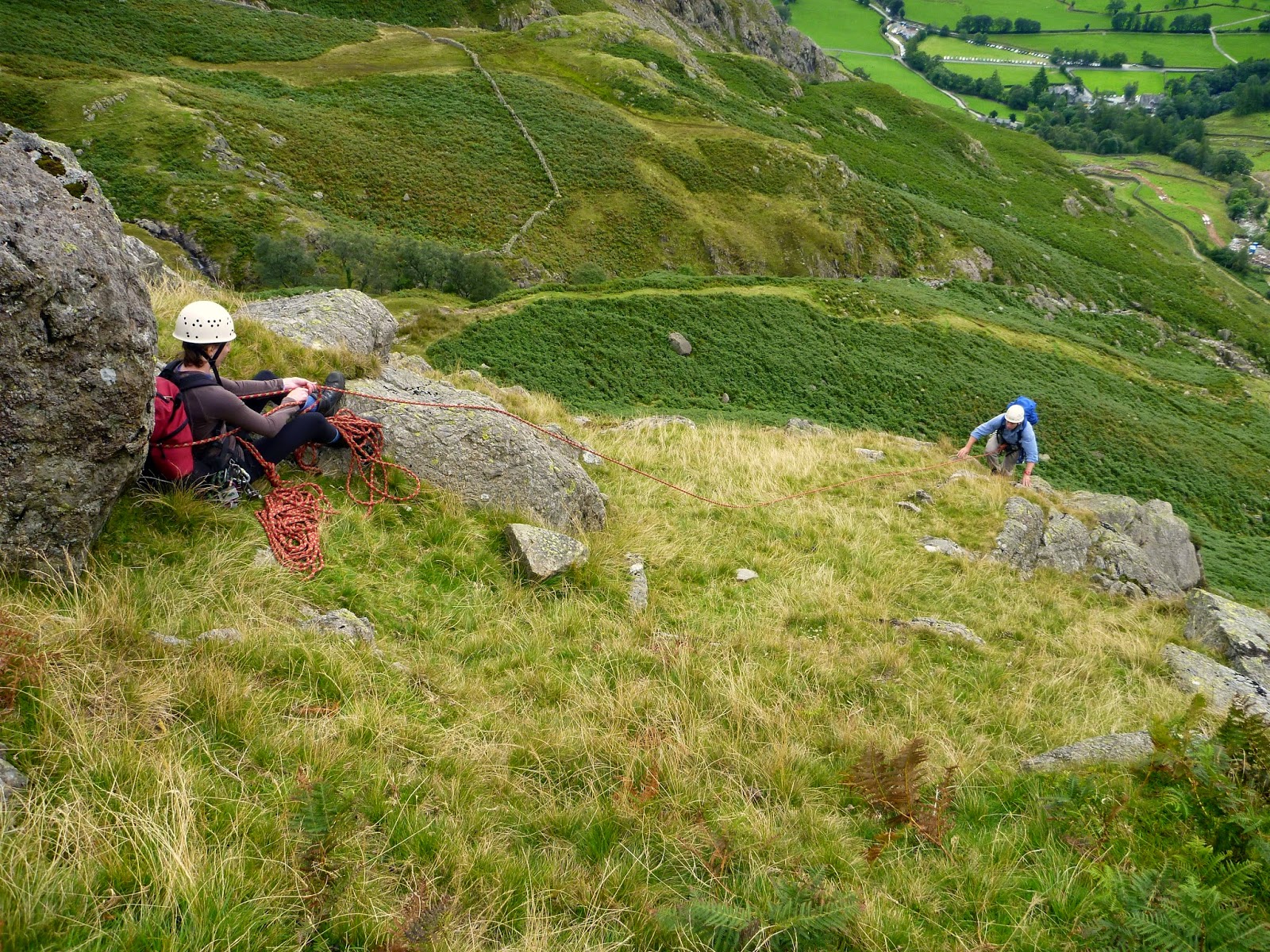
Photo two sees Darren short roping Caroline up an rocky rib where spotting would not be safe. In short roping, the leader takes up chest coils which are then locked off to prevent a falling second from throttling them. The rope between leader & second is kept tight wherever possible and when "taking in" the rope, the leader will always adopt a braced stance - ie leaning away from the direction of pull should the second slip. Indeed, in photo two, Darren is doing a very good job of this!
After spending the morning and early afternoon looking at spotting & short roping techniques including anchor selection & use and other belaying techniques available, we always get our clients on to their first proper scrambling route which will be no more than grade 2 in standard.
In photo three, Darren scrambles up the second pitch of The Spur, Tarn Crag having led the previous pitch and then brought Caroline up to the stance on a tight rope before leaving her securely attached to the belay as he climbed the second pitch. Throughout scrambling up this route, he was coached in appropriate techniques by Iain
By the time we reached the top, it was time to call it a day and descend. It had been a really good first day for Darren & Caroline's Scrambling Skills Training Course in The Lake District with reasonable temperatures and dry weather; and the forecast was looking good for the next day too!
9am on Sunday saw us meeting at the National Trust Car Park at Sticklebarn Tavern and heading to Tarn Crag again.
This time we climbed a different route - the East Rib, also grade 2, but this time Caroline led the scramble and she did a really good job too. Iain scrambled alongside Caroline coaching her in belaying techniques. In photo four Caroline was using an Indirect or Body Belay which she picked up very quickly. This sort of belay is only appropriate on easy sections of scrambling terrain and is very quick to set up!
After the morning consolidating Caroline's scrambling skills on the East Rib, we headed over the top of Tarn Crag and across to the foot of Jacks Rake on Pavey Ark.
Jack's Rake is only given grade one in the Lake District Scrambles South Cicerone Guidebook, but Iain believes it to be undergraded. It is one of the classic Lake District Scrambling ticks for many people but it also attracts a lot of people who turn up to climb it without decent walking boots, no helmets, harnesses or ropes and basically - no idea!
Today we found ourselves in a queue of just such people whom had become "stacked up" at a tricky step at the top of the first section. Fortunately, with the scrambling ropework skills the pair had learnt already, Darren was able to overtake this large, slow & inexperienced party and then bring up Caroline safely, quickly and efficiently (photo five). Once past these people, we were able to remain ahead and enjoy the rest of the varied and pleasant scrambling Jack's Rake has to offer.
Our Scrambling Skills Training Courses in The Lake District allow you to develop the skills to climb the Lake District mountains by the most exhilarating routes - leaving most hill walkers behind and getting into some great positions in relative peace.
There are some fantastic scambling routes all over the Lake District. Examples include Slab & Notch Route on Pillar Rock, Sharp Edge on Blencathra, Jacks Rake in Langdale, Striding Edge on Helvellyn and Low Water Beck/Brimfell Rib as an alternative route to the top of the Old Man of Coniston.
During one of our two day Scrambling Skills Training Courses in The Lake District, you'll develop all of the ropework and belaying skills to help you correctly select the appropriate belay method for any situation to allow you to go, with confidence, on to any of the country's great scrambles in Snowdonia, The Lake District and Scotland.
Our Scrambling Skills Training Courses can be run in any of these areas and our prices start at £80 per person per day with helmets, harnesses, ropes and scrambling rack all included as part of the fee as well as tuition from qualified Mountaineering Instructors. You can choose from one or two day courses; and if you really just want to have a great day out scrambling, but being looked after - then why not consider being guided by us on some classic Lake District scrambling routes? Contact us here to arrange your scrambling course. We look forward to working with you.

After having been out on a few previous occasions with friends who had gotten into difficulties somewhat when attempting classic scrambling routes in the UK, both Darren & Caroline had decided that it was time to take some proper tuition in scrambling from a Mountaineering Instructor and had booked their course with Kendal Mountaineering Services way back in January.
Iain took the pair to Tarn Crag in Langdale where we spent the morning of day one looking at basic skills required for scrambling on easy ground. Photo one sees the pair employing the techniques of "spotting". Spotting requires the use of hands and a braced stance and is used when going up steep steps or coming down. Hands are used to hold feet in place or press into backs or backsides - the idea is to prevent a slip turning into something more serious. Using the technique of spotting allows one to make good progress on easy scrambling ground where the use of a rope would be really uneccessary and would only slow up proceedings.
Scrambling terrain is to be found between walking terrain and Rock Climbing. Grade 1 ground refers to terrain where there is little chance of a fall turning into something more serious. As the slope angle gets steeper and a fall becomes more likely - then the rope must be employed.
Photo two sees Darren short roping Caroline up an rocky rib where spotting would not be safe. In short roping, the leader takes up chest coils which are then locked off to prevent a falling second from throttling them. The rope between leader & second is kept tight wherever possible and when "taking in" the rope, the leader will always adopt a braced stance - ie leaning away from the direction of pull should the second slip. Indeed, in photo two, Darren is doing a very good job of this!
After spending the morning and early afternoon looking at spotting & short roping techniques including anchor selection & use and other belaying techniques available, we always get our clients on to their first proper scrambling route which will be no more than grade 2 in standard.
In photo three, Darren scrambles up the second pitch of The Spur, Tarn Crag having led the previous pitch and then brought Caroline up to the stance on a tight rope before leaving her securely attached to the belay as he climbed the second pitch. Throughout scrambling up this route, he was coached in appropriate techniques by Iain
By the time we reached the top, it was time to call it a day and descend. It had been a really good first day for Darren & Caroline's Scrambling Skills Training Course in The Lake District with reasonable temperatures and dry weather; and the forecast was looking good for the next day too!
9am on Sunday saw us meeting at the National Trust Car Park at Sticklebarn Tavern and heading to Tarn Crag again.
This time we climbed a different route - the East Rib, also grade 2, but this time Caroline led the scramble and she did a really good job too. Iain scrambled alongside Caroline coaching her in belaying techniques. In photo four Caroline was using an Indirect or Body Belay which she picked up very quickly. This sort of belay is only appropriate on easy sections of scrambling terrain and is very quick to set up!
After the morning consolidating Caroline's scrambling skills on the East Rib, we headed over the top of Tarn Crag and across to the foot of Jacks Rake on Pavey Ark.
Jack's Rake is only given grade one in the Lake District Scrambles South Cicerone Guidebook, but Iain believes it to be undergraded. It is one of the classic Lake District Scrambling ticks for many people but it also attracts a lot of people who turn up to climb it without decent walking boots, no helmets, harnesses or ropes and basically - no idea!
Today we found ourselves in a queue of just such people whom had become "stacked up" at a tricky step at the top of the first section. Fortunately, with the scrambling ropework skills the pair had learnt already, Darren was able to overtake this large, slow & inexperienced party and then bring up Caroline safely, quickly and efficiently (photo five). Once past these people, we were able to remain ahead and enjoy the rest of the varied and pleasant scrambling Jack's Rake has to offer.
Our Scrambling Skills Training Courses in The Lake District allow you to develop the skills to climb the Lake District mountains by the most exhilarating routes - leaving most hill walkers behind and getting into some great positions in relative peace.
There are some fantastic scambling routes all over the Lake District. Examples include Slab & Notch Route on Pillar Rock, Sharp Edge on Blencathra, Jacks Rake in Langdale, Striding Edge on Helvellyn and Low Water Beck/Brimfell Rib as an alternative route to the top of the Old Man of Coniston.
During one of our two day Scrambling Skills Training Courses in The Lake District, you'll develop all of the ropework and belaying skills to help you correctly select the appropriate belay method for any situation to allow you to go, with confidence, on to any of the country's great scrambles in Snowdonia, The Lake District and Scotland.
Our Scrambling Skills Training Courses can be run in any of these areas and our prices start at £80 per person per day with helmets, harnesses, ropes and scrambling rack all included as part of the fee as well as tuition from qualified Mountaineering Instructors. You can choose from one or two day courses; and if you really just want to have a great day out scrambling, but being looked after - then why not consider being guided by us on some classic Lake District scrambling routes? Contact us here to arrange your scrambling course. We look forward to working with you.
Wednesday, 27 August 2014
Rock Climbing Skills Training Courses in The Lake District. Friday 22nd August 2014.
Well, it was good news that the weather last Friday was going to be dry & sunny - especially as we had a Rock Climbing Skills Training Course in the Lake district to run for Sarah Payne and Kathryn West.
Both had come to us enquiring about Rock Climbing Skills Training Courses separately; and whilst we will certainly run courses for one person, we cannot teach multi-pitch rock climbing skills - unless two people turn up as a climbing pair.
So why is this? Well, multi-pitch rock climbing usually involves two or more people working together to climb a rock face. One person will be leading and stitching themselves to the rock by means of running belays and being attached to a climbing rope being paid out by the "second" - the person who subsequently follows the leader up the climb.
As Mountaineering Instructors, we have a duty of care to our clients and if two people turn up to learn climbing then it is possible for the instructor to "self line" - that is to set up a climbing rope alongside an intended climbing route from which to be able to coach; and keep safe, a novice climbing leader.
However, if one person turns up on their own then the climbing session must become a "guided" climbing session in which the Mountaineering Instructor acts as lead climber at all times to protect the client. However, in this situation it is not possible to allow a novice to lead and this was not what either Sarah or Kathryn wanted!
Both have been out climbing as competent seconds with other leaders, but both wanted to learn to lead rock climbs for themselves. However, neither had been able to arrange a climbing partner to join them and share the cost of our fee for a Rock Climbing Skills Training Course in The Lake District.
So Iain put the two in touch with each other as they were keen to work together on this climbing course and find a date that was mutually suitable and one on which Iain could work with them to provide coaching.
Unfortunately, we had to cancel a previous convenient date when the weather refused to co-operate. This was on Sunday August 10th, when hurricane Bertha had crossed the Atlantic to lash our district with torrential rain and strong winds.
There was no point whatsoever in attempting to teach rock climbing skills in those conditions, but fortunately, the pair were able to reschedule to the 22nd of August instead.
We spent a few hours in the morning at Lower Scout Crag in Langdale looking at anchor placements and equalising anchors (photo one) to a central attachment point before heading up to Route One at Upper Scout Crag to get on with some climbing.
Sarah & Kathryn each led at least one pitch on this route (photo two) and got to practise the skill of good anchor placements, extending anchors for running belays; and equalising two anchors bringing them together to a central attachment point which is essential when belaying from a stance as Kathryn is doing in photo three.
As part of our Multi-Pitch Rock Climbing Skills Training Course in The Lake District - as well as teach you how to lead rock climbs competently and safely, we also consider it very important that you learn the techniques necessary to perform an abseil retreat from a crag.
Why might you need to do this? For a number of reasons! The weather may have deteriorated and climbing has become a cold & uncomfortable proposition, chilly people do not climb well and mistakes might result in an accident. Or, it may be getting dark! Other reasons might include people feeling suddenly unwell or someone getting injured; or, one might just decide that the climb is beyond their ability.
We showed Sarah & Kathryn the techniques for arranging an abseil retreat from a convenient oak tree on pitch two of Route Two. This involved 1. Attaching to the anchor (a sling around the tree) using cowstails before both untied from the rope. 2. Threading the rope through the anchor and then dropping both sides down to the foot of the crag before 3. Attaching to the climbing rope with their belay plates as in a "Stacked Abseil" before following Iain down to the foot of the crag as in photo four.
The pair thoroughly enjoyed their Rock Climbing Skills Training Course in The Lake District with Iain and have booked another day out with us in September - let's just hope that the weather is kind to us then!
To learn more about rock climbing skills contact us to book your own course here. As long as we have dry weather - such courses can be run, usually up until the end of October. You'll have a great time and learn a lot on one of our Rock Climbing Skills Training Courses in The Lake District - so get one booked today!
Both had come to us enquiring about Rock Climbing Skills Training Courses separately; and whilst we will certainly run courses for one person, we cannot teach multi-pitch rock climbing skills - unless two people turn up as a climbing pair.
So why is this? Well, multi-pitch rock climbing usually involves two or more people working together to climb a rock face. One person will be leading and stitching themselves to the rock by means of running belays and being attached to a climbing rope being paid out by the "second" - the person who subsequently follows the leader up the climb.
As Mountaineering Instructors, we have a duty of care to our clients and if two people turn up to learn climbing then it is possible for the instructor to "self line" - that is to set up a climbing rope alongside an intended climbing route from which to be able to coach; and keep safe, a novice climbing leader.
However, if one person turns up on their own then the climbing session must become a "guided" climbing session in which the Mountaineering Instructor acts as lead climber at all times to protect the client. However, in this situation it is not possible to allow a novice to lead and this was not what either Sarah or Kathryn wanted!
Both have been out climbing as competent seconds with other leaders, but both wanted to learn to lead rock climbs for themselves. However, neither had been able to arrange a climbing partner to join them and share the cost of our fee for a Rock Climbing Skills Training Course in The Lake District.
So Iain put the two in touch with each other as they were keen to work together on this climbing course and find a date that was mutually suitable and one on which Iain could work with them to provide coaching.
Unfortunately, we had to cancel a previous convenient date when the weather refused to co-operate. This was on Sunday August 10th, when hurricane Bertha had crossed the Atlantic to lash our district with torrential rain and strong winds.
There was no point whatsoever in attempting to teach rock climbing skills in those conditions, but fortunately, the pair were able to reschedule to the 22nd of August instead.
We spent a few hours in the morning at Lower Scout Crag in Langdale looking at anchor placements and equalising anchors (photo one) to a central attachment point before heading up to Route One at Upper Scout Crag to get on with some climbing.
Sarah & Kathryn each led at least one pitch on this route (photo two) and got to practise the skill of good anchor placements, extending anchors for running belays; and equalising two anchors bringing them together to a central attachment point which is essential when belaying from a stance as Kathryn is doing in photo three.
As part of our Multi-Pitch Rock Climbing Skills Training Course in The Lake District - as well as teach you how to lead rock climbs competently and safely, we also consider it very important that you learn the techniques necessary to perform an abseil retreat from a crag.
Why might you need to do this? For a number of reasons! The weather may have deteriorated and climbing has become a cold & uncomfortable proposition, chilly people do not climb well and mistakes might result in an accident. Or, it may be getting dark! Other reasons might include people feeling suddenly unwell or someone getting injured; or, one might just decide that the climb is beyond their ability.
We showed Sarah & Kathryn the techniques for arranging an abseil retreat from a convenient oak tree on pitch two of Route Two. This involved 1. Attaching to the anchor (a sling around the tree) using cowstails before both untied from the rope. 2. Threading the rope through the anchor and then dropping both sides down to the foot of the crag before 3. Attaching to the climbing rope with their belay plates as in a "Stacked Abseil" before following Iain down to the foot of the crag as in photo four.
The pair thoroughly enjoyed their Rock Climbing Skills Training Course in The Lake District with Iain and have booked another day out with us in September - let's just hope that the weather is kind to us then!
To learn more about rock climbing skills contact us to book your own course here. As long as we have dry weather - such courses can be run, usually up until the end of October. You'll have a great time and learn a lot on one of our Rock Climbing Skills Training Courses in The Lake District - so get one booked today!
Monday, 25 August 2014
Canyoning in The Lake District. August 21st 2014.
Last Thursday, Iain ran one of our popular Canyoning Sessions in The Lake District at Church Beck near Coniston. Frank Donoghue, together with his son Harry & daughter Tess had made the journey down from Keswick, where they were staying on holiday to join Iain at this venue.
Canyoning is all about descending a mountain stream, abseiling; or as in photo one - being lowered down waterfalls; and in this photo Frank goes first. The drop behind him is not very high - only about 10 feet into the pool below, but the act of passing through a waterfall is a truly exhilarating experience!
Photo two was taken a little further downstream after we had abseiled the waterfall at the head of the gorge; and then jumped into a deep pool at the fall below. We were the only party in Church Beck on this Thursday afternoon which we thought a little odd; although the weather was pretty rubbish with a strong wind blowing and the rain lashing down.
What better thing to do on your visit to The Lake District if the weather is poor - come Canyoning or Ghyll Scrambling with us! Both are ideal & fun ways to occupy a miserable day and you can't get any wetter!
A little further beyond where photo two was taken one arrives at Miner's Bridge spanning the gorge. Immediately below here is the Miners Bridge Waterfall and in photo three - Tess scrambles backwards towards the top of the fall to be lowered down by Iain.
Below the Miners Bridge Waterfall, the gorge narrows in to section known as The Top Jumps - three waterfalls and deep pools in quick succession. To keep you safe, we belay you (protect you with a rope) as you climb out to us to avoid the narrow slot of the first fall and then lower you to a point where you can jump, without fear of hitting the rock sides, in to the pool below. We climb down the next waterfall and swim the pool below to then slide down the final fall using a big sloping rock slab as the launching point.
That big slab can be seen in photo four behind Frank with the water falling down either side of it.
On your Canyoning Descent of Church Beck we can continue downstream from this point for a further 300 metres and then turn around to do a roped climb up a waterfall passed in descent and also a "tricky traverse" across a rock wall at the back of the pool above, penalty for falling off - a thorough ducking!.
We finish off by climbing out of the left bank of the gorge (behind the trio in photo four) and ascending then descending to a point some 20 feet above the pool that is above the chockstone fall seen here. We do the jump into that pool before doing the slide behind Harry Tess and Frank one last time. We find this is a great finale to the Canyoning Session and it is the biggest jump in the gorge.
Canyoning is great exhilarating and challenging fun and our prices start at just £45 per person for a four hour session. All of the equipment you see Frank, Harry & Tess wearing is provided as part of your fee. All you need to bring is swimwear, towels, a long sleeved fleece type top and a pair of thick socks to wear in the walking boots we provide. Oh! - and don't forget plenty of enthusiasm! We can guarantee you'll love Canyoning. Contact us here to book your session. We look forward to working with you.
Canyoning is all about descending a mountain stream, abseiling; or as in photo one - being lowered down waterfalls; and in this photo Frank goes first. The drop behind him is not very high - only about 10 feet into the pool below, but the act of passing through a waterfall is a truly exhilarating experience!
Photo two was taken a little further downstream after we had abseiled the waterfall at the head of the gorge; and then jumped into a deep pool at the fall below. We were the only party in Church Beck on this Thursday afternoon which we thought a little odd; although the weather was pretty rubbish with a strong wind blowing and the rain lashing down.
What better thing to do on your visit to The Lake District if the weather is poor - come Canyoning or Ghyll Scrambling with us! Both are ideal & fun ways to occupy a miserable day and you can't get any wetter!
A little further beyond where photo two was taken one arrives at Miner's Bridge spanning the gorge. Immediately below here is the Miners Bridge Waterfall and in photo three - Tess scrambles backwards towards the top of the fall to be lowered down by Iain.
Below the Miners Bridge Waterfall, the gorge narrows in to section known as The Top Jumps - three waterfalls and deep pools in quick succession. To keep you safe, we belay you (protect you with a rope) as you climb out to us to avoid the narrow slot of the first fall and then lower you to a point where you can jump, without fear of hitting the rock sides, in to the pool below. We climb down the next waterfall and swim the pool below to then slide down the final fall using a big sloping rock slab as the launching point.
That big slab can be seen in photo four behind Frank with the water falling down either side of it.
On your Canyoning Descent of Church Beck we can continue downstream from this point for a further 300 metres and then turn around to do a roped climb up a waterfall passed in descent and also a "tricky traverse" across a rock wall at the back of the pool above, penalty for falling off - a thorough ducking!.
We finish off by climbing out of the left bank of the gorge (behind the trio in photo four) and ascending then descending to a point some 20 feet above the pool that is above the chockstone fall seen here. We do the jump into that pool before doing the slide behind Harry Tess and Frank one last time. We find this is a great finale to the Canyoning Session and it is the biggest jump in the gorge.
Canyoning is great exhilarating and challenging fun and our prices start at just £45 per person for a four hour session. All of the equipment you see Frank, Harry & Tess wearing is provided as part of your fee. All you need to bring is swimwear, towels, a long sleeved fleece type top and a pair of thick socks to wear in the walking boots we provide. Oh! - and don't forget plenty of enthusiasm! We can guarantee you'll love Canyoning. Contact us here to book your session. We look forward to working with you.
Subscribe to:
Posts (Atom)