Wednesday, 26 February 2014

Winter Skills Courses in the Cairngorms. February 17th & 18th 2014

Bryn Anderson booked this five day bespoke Winter Course for himself & his son Joel and friends Bill who came along with his son Jono; and also their mate - Martin. We were also joined by Iain's friend Cressida (Cress) Allwood who, contemplating her Winter Mountain Walking Leader Assessment had asked if she could shadow this course.

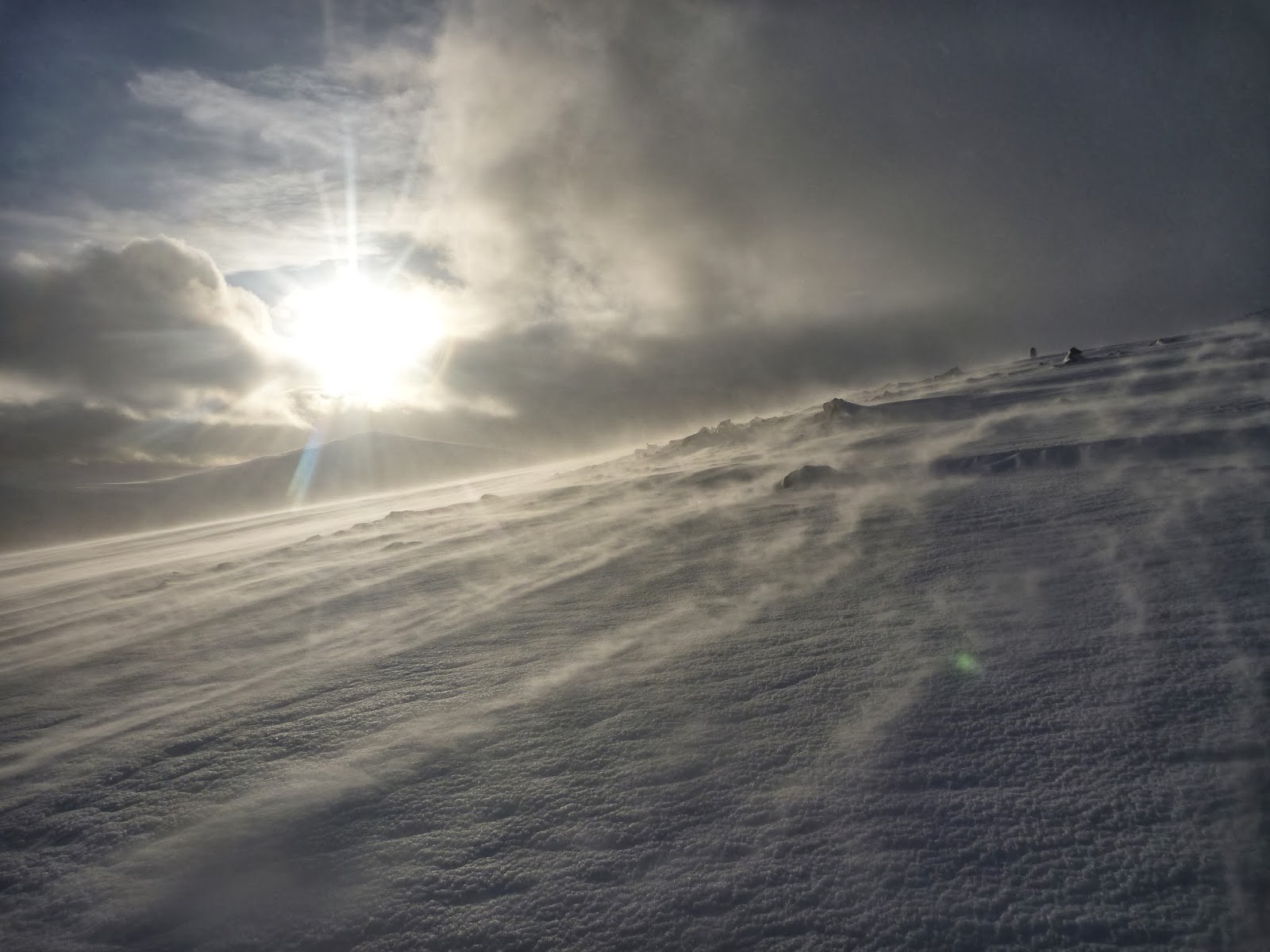
The first two days of the groups course consisted of a Winter Skills Course - undertaken in The Cairngorms. Photo one shows the team on the lower slopes of Cairngorm's North Ridge on our way to try & find a decent snow slope to look at Ice Axe Braking. We had already covered using the boot as a tool by this point.

Photo two shows the group at our Ice Axe Braking venue on Mam Suim (part of the north ridge of Cairngorm) and here, Bill is having a go at braking.

There are various permutations of Ice Axe Braking - on your front feet first is the way you want to finish up so that you can dig that ice axe pick into the snow under your chest and stop a slide. However, a slip can start in many ways - feet first on your back as well as your front or worse - head first on your back or front, or even a cartwheel! Iain demonstrated all of these types of fall and how to arrest before everyone else in the group followed suit. It was a good session!

It is amazing how quickly the day will pass when practising all manner of Winter Skills and before we knew it, there was only an hour left before it would be time to head off the hill. As the snow at the Ice Axe Braking site was suitable for looking at snow anchors Iain demonstated a horizontal buried axe belay.

This involves cutting a horizontal slot across the fall line of the slope the length of the axe and deep enough that when loaded, the axe will be braced against a layer of solid snow (preferably neve) which serves as the anchor. It is important that the slot is cut in such a way that when loaded - the axe will receive a sideways and downward pull. To attach the rope to the axe a sling is used attached to the axe with an inverted Clove Hitch and placed  in a vertical slot cut in such a manner that once again, the load on the axe is always sideways and down. The rope is then attached to a sling with a karabiner.

Photo two shows the whole group (six persons) trying to test a buried axe belay to destruction. How easy they failed would be an indication of just how well each individual had constructed theirs. Everyone had to make their own buried axe belay and then we had a fair bit of fun trying to destroy them. Most held with a steady pull, however, through tugging (shock loading) a few did fail. However, this was an opportunity to see that a well constructed snow belay in good snow can be quite strong!

The weather on Monday had been quite mild with the freezing level only at around the altitude we had been working. Winds were light and precipitation, negligable. Tuesday was looking similar so, in a bid to find better conditions, we had an earlier start in order that we might get into the upper car park at the Cairngorm Mountain Ski Area at Coire Cas and get high up on the mountains.

We had quite a walk to get to Ciste Mhearaidh - our venue for the day at 1050m just below the summit of Cairngorm. We had been told that conditions here were good for Winter Skills and on arriving, we found a massive snow hole (photo four) which was an ideal place to have lunch.

The walk in to Ciste Mhearaidh was quite interesting. We had to avoid the many skiers on our walk up to the Ptarmigan Restaurant and from there to our venue it was a walk in thick cloud (whiteout conditions) across around 500m of low angled slope to get there.

The whiteout conditions continued to prevail at Ciste Mhearaid. On arrival, we had some lunch in the snowhole and then ventured out to get our bearings and find out what snow slopes were available to use for our Winter Skills Session.

Amongst other things - we did find was this massive hazard - fortunately well consolidated! Photo five sees Bill standing underneath a ten foot high cornice and in places it was even higher! These are formed at the top of a lee slope when snow, carried along by a strong wind, is deposited creating an overhanging lip. Cornices are very dangerous things that can collapse creating an avalanche or frequently, people can walk over them in conditions of poor visibility such as a whiteout; or fall through them whilst trying to get a view down to ground below! From above, this was hazard was virtually invisible in the whiteout conditions today!

Time was getting on after our long walk in to Ciste Mhearaidh so after our discussion about hazards such as cornices we continued on with our theme of snow belays from the previous day. In photo six Cress is sat in a bucket seat and is using a body (indirect) belay to safeguard a person climbing the slope towards her.

A bucket seat belay is a very basic snow belay used to safeguard some one on an easy climb such as a grade 1 or 2 snow gully. If the integrity of the snow is in doubt then one would "back it up" by also using something such as a Buried Axe Belay, Snow Bollard or Deadman. Iain demonstrated all of these snow belays and then everyone had to construct and test their own - more fun for the group tugging on ropes again! Many might consider including snow belays as part of a Winter Skills Course unnecessary, but as a day of winter climbing was planned for later on during this week, Iain considered that thes would be useful skills to learn and indeed, these were new techniques to everyone in our group!

After practising the remaining snow belay techniques we had a wander around the various types of snow shelter that had been constructed by previous groups. As well as the obvious massive snow hole there were various "lean to, sitting bivvis" and a "snow grave". We discussed how to construct the various types of snow shelter before packing up and setting off back to The Ptarmigan Restaurant - doing the return journey to our vehicles in under an hour! Photo seven taken on our walk out shows just what the day was like - still whiteout conditions!

However, there had been no wind; and even though the MWIS forecast had predicted the freezing level would be around 800m, we reckoned that even at 1050m it had barely been freezing - if at all! Conditions had been pleasant even if the visibility was poor.

Today had not been a bad a day at all but there we still aspects of the Winter Skills Syllabus that were yet to be covered. However, there was still time with another three days of this Winter Course in The Cairngorms to run.

Wednesday, 12 February 2014

Mixed Winter climbing in The Lake District. Bowfell Buttress, Monday 10th February, 2014.

Not all of the posts on our blog relate only to the work that we do at Kendal Mountaineering Services. Sometimes Iain likes to mention the other things that he gets up to in the outdoors - so here he goes!

Towards the end of last week I received an invite to join a mate - Dave, for some winter climbing, if suitable conditions presented themselves in the area.

We all know about what a poor winter it has been so far as low pressure systems have tracked one after the other across the country bringing with them copious amounts of rain, strong winds and mild temperatures. None of these are conducive to "good" winter conditions and so far this season, The Lakes have seen little of such conditions.

However, Dave seemed to think that Monday was going to be a settled day and that there would be "winter conditions" higher up. We left Kendal at 06:00 and set off on the walk in to Bowfell Buttress from Langdale at about 07:00. In the valley it was mild and everywhere was green. As it got lighter, we could make out some snow peeping out from under the cloud shrouding Crinkle Crags!

As we reached the point where the Climbers Traverse path breaks from the main path to Three Tarns (at about 600m) there was a distinct "bite" to the air and we were already in snow. The Climbers Traverse (photo one) was tricky, banked out with snow having a thin hard crust but being deep & soft underneath resulting in our constantly breaking through - for me at times - right up to the tops of my legs. This was not a place to slip today, the slope below the path is preciptitous and and an Ice Axe would not have stopped you! Today, the traverse was best described as arduous!

At least the weather was calm. There was no wind when we arrived at the foot of our route and it would remain this way all day. Also, there was virtually no precipitation during the day either, but it was to remain largely cloudy.

As a winter route, Bowfell Buttress is given a grade of V'6, in Summer it is one of the areas classic Rock Climbs and given the grade of Vdiff in the FRCC Langdale guide. Overall, it is 110m long and generally climbed in four pitches, however, as we had my 2 60m ropes, Dave decided to pitch the route in two ropelengths.

Here in photo two, Dave can be seen leading off on the first pitch, the route was thin and conditions not great. However, after the early start and long walk in, we weren't for turning back  particularly as the weather seemed so settled! 
Time passed slowly as it can do on winter climbs, but this was largely due to Dave having fun with the cruddy conditions we found on the route. Being barely freezing - it was more a case of torquing and hooking rather than being able to bash picks into lovely frozen turf or ice. It was quite a while before the ropes went tight on me indicating I could climb. The chimney at the top of the first pitch gave me considerable difficulty but eventually I joined Dave on the spacious midway ledge.

Dave led off up the next steep wall and across the traverse knocking off loads of snow & ice as he went. I knew he was traversing as initially, all the rubbish was falling down to my right, then on my head and then off to my left! Dave reckoned that the final chimney was the crux (hardest part) of the route and whilst moving on the exposed start to that chimney was exciting, I certainly found the second two pitches easier than the first. Photo three sees Dave at the final stance as I climbed up to join him.

At the top of the final pitch things were properly frozen - even the turf. We peeled off down the l/h slanting couloir leading into the gully to the south of the buttress and descended through crappy snow back to the sacks and after a bite to eat, packed up and left.

It was good to get off the Climbers Traverse and on to turf - even in a pair of Nepal Extremes! It was no less knackering a return journey to this point (photo four) than it had been on the way in with my constantly floundering about in the deep soft snow. At least I was getting a good workout!

However, it was a good, long hard day out and nice to have been out on one of the areas classic mixed winter routes in what, other than the cloud, had been a decent day. The views as we descended back to Langdale were fantastic! Thoroughly satisfying stuff!

There is still time for the weather to cool down and hopefully we will see better winter conditions spread to a lower level in The Lakes so for anyone interested in learning Winter Skills or winter climbing we are available to take you out. Contact Iain at Kendal Mountaineering Services if you are interested. His next post is likely to be about a winter adventure booked with four clients in The Cairngorms next week. Happy winter climbing!

Caving sessions in the Yorkshire Dales National Park. Wednesday 29th January 2014.

Winter in The Lake District can be a cold, wet time of year and so far the winter of 2013-14 has been just that! However, you can still get out and have an adventure with Kendal Mountaineering Services and either wrap up warmly - or go underground!

That was exactly the though of Beccy Phillips and Aldene Woodward when they booked an Introductory Caving Day in the Yorkshire Dales National Park with Iain.

Photo one shows the pair as we made our way underground from Diccan entrance in Long Churns - one of the areas best introductory caving venues.

The pair enjoy spending time in the outdoors - hillwalking & mountain biking amongst other things and on this visit to The Lake District, had decided to try caving. The weather was ok, cool but not too windy or wet and water levels were moderate in Long Churns.

As an army group arrived around about the same time as us, Iain took the pair straight in via the shortest route to The Cheese Press (photo two) where Al can be seen here giving this famous tight squeeze a go. Good effort!

After trying The Cheese Press for size, we visited the top of The Dolly Tubs Pitch where daylight was clearly visible entering from Alum Pot before heading upstream visiting Middle Entrance and then Cross Passage (Baptistry Crawl).

After revisiting Middle Entrance from its upstream entrance, we then continued on through Upper Long Churns to exit via the waterslide at Doctor Bannisters Washbasin.

There was as much water as we wanted in Long Churns today, any more would have certainly made the fall at Doctor Bannisters a bit tricky but as it was, this "up for it" pair took everything in their stride! Beccy can be seen doing exactly that in photo three as she "bridges" across a notorious deep pool in Upper Long Churns.
The pair were quite keen to try something harder in the afternoon so Iain offered them the option of a level 2 Caving Session in the Calf Holes/Browgill system. If you are wondering what the difference is a Level One Caving Session has vertical drops of no more than 2m involved whereas a level 2 Session has vertical pitches of up to 18m (60 feet) involved. The entrance pitch to Calf Holes is 11m (33 feet).

A level 2 Caving Session is therefore a more serious proposition and requires more equipment and skill to keep people safe, but Calf Holes is a relatively straightforward pitch and easy to manage. So, Iain was happy to lower the pair down so that we could then investigate downstream in Browgill Cave.

There was as much water in Browgill Cave today as Iain wanted to see and indeed the volume and noise of the water made it seem a more challenging environment than Long Churns. After lowering the pair down the Calf Holes Pitch, we made our way downstream, squeezed through Hainsworths Passage and "The Slot" and descended to marvel at the absolutely thundering waterfall below. Shortly afterwards, we emerged at the downstream exit (photo four) where the pair, were happy to call it a day.

This exciting, adventurous & challenging Caving Day in The Yorkshire Dales National park cost Beccy & Aldene £75 each. For that they got a full day out with a qualified & experienced Cave Leader and were provided with all of the equipment you can see them wearing. To book your caving session with us contact Iain here. Caving is one thing you can do underground when above ground - the weather might not be fit to do much. Our caving trips usually start with our meeting at Inglesport in Ingleton - the areas best outdoor sports shop with it's legendary cafe.

Tuesday, 28 January 2014

Scottish Winter Mountain fest. Saturday 18th - Sunday 26th January 2014

Some followers of our website and blog may recognise this photo taken of Chris Upton (foreground) & Adam Dawson taken during one of our successful trips to traverse the Cuillin Ridge of Skye in May 2008.

That particular trip to the ridge was actually, our best ever, to date! The weather was perfect and we managed a complete traverse of the ridge including an ascent of the Inaccessible Pinnacle and a traverse of the notorious Thearlaich Dubh Gap.

Chris & Adam have both attended a number of our courses in addition to the Cuillin Ridge trip. These include a lake District based Scrambling Skills Training Course and both have attended our Scottish Winter Skills and Winter Climbing Courses.

The pair have become firm friends with Iain and now descend upon us annually to share the fantastic experience that is the Kendal Mountain Festival taking place here each November

During the last visit, Adam & Chris discussed the idea of a week of Winter Climbing in Scotland in January and asked Iain if he would like to join them? From Iain's perspective this would not be a work trip, so would it be worth it? Well, you'll have to read on to find out!


The dates were set from Saturday 18th until Sunday 27th January. The plan was that Iain would drive up from The Lake District and Adam would get the train up from London on the Friday evening, both arriving at Chris's home in Kirriemuir, Angus.

Chris is a member of the Carn Dearg Mountaineering Club who have a hut in Glen Doll - home to great winter climbing venues such as Winter Corrie and Corrie Fee. However, the lack of winter weather we had not banked on; and for the entire weekend, we found ourselves lashed with rain. Photo two shows Chris & Adam as we walked into Corrie Fee on Saturday afternoon where we almost made it to the summit of Mayar before turning back in the cold, wet & windy whiteout conditions to be found high up.

After a night in the club hut drying out in front of the logburner, we again ventured forth on Sunday. The River South Esk had risen dramatically and was now lapping at the nearby picnic bench. We decided to walk a circuit taking in the valley of the South Esk and then cutting across high up to return via the head of Glen Doll back to the hut.

Walking up the Esk Valley, the flooding was dramatic and really, wellies would have been more appropriate. Iains feet remained dry until we were forced to cross the stream in photo three, fortunately we had nothing larger than this to ford today!

The rain continued to lash down as we ate lunch in the dramatic larch woodland of Bachnagairn. Upon heading over the bealach to upper Glen Doll, we briefly encountered winter conditions when the preciptiation turned to snow! Evening was spent once again drying out in the hut and enjoying some beers in the nearby Glen Clova Hotel.

Monday saw us return to Chris's in Kirriemiur, shower; and pack to head north to Aviemore via Perth where Adam bought a new pair of Scarpa Manta Pros to replace his leaky walking boots. It was a pleasant drive in good weather and we arrived in good time - dining at the nearby Winking Owl that evening - having already prepped for the following days climbing planned in the Northern Corries of The Cairngorms.

On Tuesday, we awoke to the sound of the wind roaring in the trees outside of Karn House. This did not sound a good omen and indeed, on setting off for the ski area at Coire Cas, Iain noticed the ominous cloud cap covering The Cairngorms (photo four).

When the view is like this, you can forget any prospect of Winter Climbing in the Northern Corries. We visited Coire Cas anyway where uplift was "on hold" and the car park was being blasted by a gale. No climbing in the Northern Corries today then!

As an alternative - for a walk at least, Iain suggested heading into Glen Feshie and taking a walk up Coire Garbhlach. This corrie can be seen like a giant ravine - cutting into the western edge of The Cairngorm Plateau when driving north to Aviemore on the A9.

The rim of the corrie has a considerable number of short winter climbs from grade II to V in difficulty although today, topping out after a climb into the roaring gale and maelstrom of spindrift would have been a fools plan. As it was, we followed the Allt Coire Garbhlach all the way to the cornice at the edge of the plateau where Iain poked his head out and then retreated back to Chris & Adam waiting below (photo five).

The final gully made for interesting winter scrambling both up and down and there were some very interesting ice formations to be found in the stream. This were the closest we had come to "full" winter conditions so far on our holiday!

The MWIS and SAIS forecasts for the following day showed both less rain and less wind. Slope aspects from NW through to NE were indicated as having "considerable" avalanche risk, however, west was ok and with a decrease in the speed of the predominantly southerly wind, we decided to go in to Lurchers Crag at the foot of the Lairig Ghru.

In order to get there from the Coire Cas access road, one parks at The Sugarbowl car park and walks SW for some 4 &1/2 km passing through the Chalamain Gap (photo six) - the site of a serious incident in February 2013 in which 2 separate groups were caught & buried by an avalance - one of them, a Glenmore Lodge party!

After passing through the Chalamain Gap, we found ourselves being lashed by a stronger than expected southerly blowing through the Lairig Ghru and also getting wet from the unexpected rain! Conditions were very damp and very cold.

After getting some food and donning waterproofs, we all geared up below some easy looking lines on the northern end of Lurchers Crag, which fortunately, was now starting to appear from under the cloud. Photo seven shows Adam leading the way on a nice little four pitch route at about grade II+ in standard. Chris can be seen belaying from the rocks below & to the right of Adam. Climbing the route took about three hours and the pair were pleased at finally being able to get stuck into what we had really come to Scotland for, unfortunately, it was to be the only real climbing that we did all week!

At the top of the route, the wind grew stronger & colder; although more gaps were appearing in the cloud through which we could see down into the Spey Valley and towards Aviemore.

We found a large rock behind which to shelter and where we could "de-kit; although we decided to keep crampons on and an ice axe handy each, as up here, the snow had a very hard crust between the layers of slab that were forming.

We headed back over the northern shoulder of Lurchers crag intending to avoid having to traverse the rocky Chalamain Gap on our return to the car. At times it was hard to stay upright because of the wind and we endured periods of whiteout along the way. Eventually, the weather cleared out though; and with the Chalamain Gap in sight, we took off our crampons in the sun (photo eight) before dropping lower - back into more rain en route for the car.

Unfortunately, Thursdays forecast was looking extremely windy again and therefore it looked as though climbing was off the agenda. Of course, as well as this holiday being about climbing, it was also about getting fit again after the excesses of Christmas. So, it was decided that a low level walk into the valley of Glen Einich would be good for us.

Photo nine sees us beyond Loch Einich and in the remote but pretty Coire Odhar. On this day we walked 25km in total gazing wistfully at the cliffs to the west under Sgorr Gaoith & Sgoran Dubh Mor where there looked to be some amazing winter lines on the buttresses above.

Photo ten looks from the northern shore of Loch Einich up to the corries under Einich Cairn. Here, there was clearly a lot of snow and some very big cornices! Down the valley, it was not particularly windy, but we could see snow being whipped up way above us.

The day had started rather windy and we had endured some heavy snow showers on our long walk in to Loch Einich; although the weather did improved during our walk around the loch. Glen Einich is a truly remote place and this was Iain's second only visit to this valley.

Despite not achieving our real goal to climb, we had a satisfying day that ended with us sampling the hospitality at the nearby MacKenzies Inn into the small hours - not the best plan for another early start on the Friday. In any event, Adam awoke to pain from a strained knee and once again in Aviemore, the wind was roaring! Friday was spent taking a rest!

On Friday afternoon, we packed ready for an early start on Saturday, driving by way of Tomintoul and The Lecht Ski area to Ballater on Deeside and on to the Spittal of Glen Muick. Objective for the day, Lochnagar.

We set off at around 9:30 again, in rain and with a roaring wind. From Iain's perspective, there seemed little point in what we were doing - particularly as conditions were only likely to be worse higher up.

After trudging through rain and slush, winter appeared at the 750m contour. Above here were "full" winter conditions indeed. We struggled on against the arctic blast, eventually reaching the summit of Lochnagar (photo eleven) around 1pm.

In view of the time, Adam in particular, was keen to bag another Munro despite the conditions. So after a short and chilly lunch stop at Lochnagar's summit, we headed west into the wind to try to locate the summit of Carn a' Choire Bhoidheach some 2.5 km distant.

This was not easy due to the whiteout conditions that prevailed, but Adam & Chris successfully found the summit of Carn a' Choire Bhoidheach confirming so by way of a Garmin Etrek (GPS) and an Iphone 4!!

We continued on in whiteout conditions toward the head of Glas Allt Falls (photo twelve) with the cloud clearing as we reached Creag a' Ghlas Allt. All that remained was a 5 km walk alongside Loch Muick back to the car and a two hour drive to Kirriemiur where after cleaning up, we hit town for several Stellas and a good hot curry.

So thats it, seven days in what was largely, a stormbound Scotland. Did we achieve our climbing objectives? Not really. A combination of wind, weather and avalanche forecasts put paid to that.

However, for Iain, the visit to Chris's home at Kirriemiur, our stay in and visit to Glen Doll, the walk around Loch Einich, the climb on Lurchers Crag and the winter ascent of Lochnagar were all new. Each day was an adventure!

Despite the poor conditions preventing us from meeting our main objectives, we had a lot of fun and some great experiences. We worked hard, got battered, soaked and frozen by the weather, everyone's morale probably hit rock bottom at some point, maybe more than once! But each day, something would happen to make us all think "yeah! that was worth it!" The company and crack also contributed to what was really, a great week; and Iain would like to thank Chris & Adam for inviting him along.

Next time - Rjukan!

Into 2014 with Kendal Mountaineering Services.

Sorry folks, we've not posted anything on the blog for ages!

December & early January have been quiet as always in the run up to Christmas and due to people subsequently being "spent up" afterwards! However, bookings are looking positive for 2014 and we already have forward bookings as far as August - some of which have come about through development of our Gift Voucher which a good number of people bought as Christmas presents for family, friends and loved ones.

We have done a little work though, Claire pictured right, booked a bespoke Navigation Skills Training day with Iain in December. As can be seen from the photo, the weather was bright & sunny if a little chilly, but ideal for a person wishing to brush up their map reading & navigation skills without having to work too hard in poor visibility.
For Iain, it was a great opportunity to deliver a Skills Training Course somewhere completely different! This course was run on Wild Boar Fell almost on the border between Cumbria & North Yorkshire.

Wild boar fell is an interesting place where the geological strata is a mixture of beds of limestone, Shale and Gritstone (known as the Yoredale Series to geologists). This produces features such as sinkholes, caves and escarpments - all useful features when you are looking for something to find on the map! Wild Boar Fell is also famous for Sand Tarn (photo two) nestling at the foot of the summit escarpment where there really is a sandy beach! We were fortunate not to see any wild boars though, in fact we did not see another person all day.

Claire gained a good foundation of Map Reading and Navigation Skills through her bespoke day out with Iain. These will certainly help her enjoy her future forays into the area's mountains, Good stuff!

As we moved into the New Year, we were contacted by Tom McGregor. Tom is the son of one of Iain's friends from his time at Agricultural College in Lancashire in the 1980's. Tom was intending to visit The Lake District with his girlfriend Adela and was looking for things to do in the area and take opportunities to visit some of his Dads old friends in the process.

Iain arranged to meet the pair for a day out in the Kentmere area which is where we run most of our advertised Navigation Skills Training Courses. Both Tom & Adela were keen to do some hill walking and combine it with some Map Reading & Navigation tuition.

As the cloud was down, we started Tom & Adela's day a walk from Green Quarter along the upper Kentmere valley looking at pacing & measuring distance as far as Kentmere Reservoir before introducing the compass for taking & walking on a bearing (photo three)

As the day went on the cloud appeared to be lifting so we took a bearing for a hilltop near to the reservoir and then on to a massive rock called the Ull Stone which must be an erratic (a rock moved by glacial ice). Using the pacing and navigational skills already taught by Iain, the pair had no trouble in locating the Ull Stone.

From there, we took a route directly to the top of Kentmere Pike so at least Tom & Adela were able to get at least one Lake District mountain top in during their visit. We then navigated successfully to a not easy to find spring before descending back to the car.

Photo four shows Iain (red jacket) with Tom near to the Ull Stone. From Iain's perspective, it was nice to spend time with the son of an old friend whom he rarely sees. Tom & Adela were a lovely young couple and Iain's mate Robert must surely be very proud of this young mans achievements.

Tom & Adela visited Iain & Kirstin in Kendal at the end of the following day - spent around Derwentwater & Keswick; they enjoyed an evening meal with us and were great company. We do look forward to seeing them again.

For further details about our advertised Navigation Skills Training Courses in The Lake District, you can check out details of the courses here and can contact us here. At £80 per person for the advertised weekend courses, these really are exceptional value!

Saturday, 7 December 2013

Guided Winter Climbing and Winter Climbing Training Courses. Lake District & Scotland, starting December 2013, ending April 30th 2014.

The Winter climbing season has already begun in the UK with a number of ascents of classic Winter climbing routes already having taken place in Scotland. True - at the present moment, it;s a little unsettled & mild, but climbing conditions are bound to improve again soon!

At Kendal Mountaineering Services, we offer a number of options to those wishing to take up Winter Climbing. Ideally, you should have experience of scrambling or climbing outdoors on dry Summer rock if you wish to learn the skills of Winter Climbing; and will also have undertaken a Winter Skills Training Course to prepare you for walking in the Winter mountain environment.

However, if you already have sufficient experience of winter walking, crampon & ice axe techniques; and wish to be guided up a Winter climb in The Lake District or Scotland, then we can organise this for you.

Wherever there are mountains - there are Winter Climbing routes. Some areas are more popular than others and aspiring Winter climbers will have heard of areas such as Glen Coe where photo one with Benn was taken on Dorsal Arete (grade II) and the Northern Corries of The Cairngorms where this photo was taken of Mark on Invernookie (grade III'4)

Other areas also include Ben Nevis and Aonach Mor near to Fort William and Creag Meagaidh midway between Fort William and Aviemore. These are all great areas for learning how to climb Winter routes and all have classic climbs that we are happy to guide on if you would just like to be led up something!

All of these areas are readily accessible and can be reached from England border in four hours to Fort William and five hours to Aviemore. Both are good places to base yourself when attending one of our Scottish Winter courses - each with a wide variety of accommodation types, restaurants and supermarkets.

And once there - you are ready to start your Winter Climbing Skills Training Course or Guided Winter Climbing day with one of our instructors. You will be met, the evening beforehand your course if necessary, to go through your equipment, make your that you have everything necessary and check crampon fitting etc.

Your instructor will provide a copy of the climbing forecast and the local avalanche report the details of which they will discuss with you. In conjunction with these, and an appraisal of your ability and aspirations for your course, your instructor will choose an appropriate route that fits all requirements.

Winter Climbing Skills Training Courses and Guided Winter Climbing days are long demanding days - so expect to get up early and experience walk ins which may be 2 hours as a minimum. Ideally, you should have a good level of hill fitness if you want to get the most out of these courses.

The type of ground you will find yourself on will be dictated by the type of course you are attending. If you are attending a Guided Winter Climbing Day such as the pair in photo three then the ground may be grade 1 through to Grade IV. In this instance, the pair were on Green Gully, Ben Nevis - a classic Winter ice climb graded at IV'3.

On our Winter Climbing Skills Training Courses you are likely to be working on ground up to, but no more than grade III in standard where you will be coached by a Mountaineering Instructor who may well be moving alongside you  - coaching you as you climb.

The three seen in photo four enjoyed a progressive Winter Climbing Skills Training Course with us - in this photo they were climbing on Dorsal Arete (grade II), Coire An Lochan, Glen Coe; and they accomplished the route well. For their second day, due to the increased avalanche forecast, Iain coached them on nearby Sron Na Lairig before guiding them through the cornice at the top of the route. Again, they climbed this route well and took away a lot of new skills with which to use in the Winter mountain environment.


Maria, seen leading in photo five, attended one of our week long courses in 2010. Maria  had attended our Scottish Winter Skills Course followed by our Cairngorms based Navigation & Snowholing 2 day course before trying her hand at Winter climbing during one of our Winter Climbing Skills Training days.

It was a perfect progression for Maria who took very well to Winter Climbing. For Chris, the progression on to snowed & iced up rock was possibly a little easier as he had previously attended one of our Lake District based Scrambling Skills Training Course, a Cuillin Ridge Traverse Trip and a Winter Skills training course with us prior to joining Maria on this route - Twin Ribs in Coire an t Sneachda in The Cairngorms
Our final photo in this post sees Benn - on the last day of his 12 day progressive Winter Climbing course booked with Iain in 2012. Rather than explain it, you can read all about Benn's course here - if you wonder what a client is doing out in front, well, sometimes this is appropriate!

Our team of Mountaineering Instructors have a considerable amount of experience climbing in Winter in both The Lake District and Scotland and they will enjoy organising an appropriate package for you in either area. Whether it be learning Winter Climbing Skills or guiding you on that classic Winter route all of our staff are passionate individuals who will be intent on providing you with the best possible experience whilst keeping you safe.

We believe we provide excellent value for money with all of our Winter Climbing Courses and these cost £150 per day for two persons or £180 per day for three. Lake District Winter Climbing Courses can be of 1 day duration, Scottish Winter Climbing Courses are a minimum of two day duration.

Contact us via the website for more details about these courses or contact Iain on 07761 483364 if you are looking for something at short notice. We look forward to working with you.

2 day Winter Navigation and Snowholing Courses in Scotland. Starting December 2013, ending April 30th 2014.

So what are your aspirations in the mountains this winter? Perhaps you might fancy a real adventure with a difference such as one of our 2 day Scottish Winter Navigation & Snowholing Courses.

These have traditionally been done in the Cairngorms - the last remaining vestige of the Arctic anywhere in the UK and the largest upland area above 914m (3000 feet) in the country. But if you would like to do yours elsewhere in the Scottish Highlands or even The Lake District - then give us a call.

To attend one of these courses, you will have already attended a Winter Skills Course and really, you should already possess a good level of map reading ability. This course is about transferring that map reading ability from walking on grass to snow where one minute you may be walking on top of a firm crust - and then next minute breaking through up to your knees! How do you pace in constantly changing walking conditions? The answer - with practice!

If you are lucky on our Scottish Navigation & Snowholing Courses, you may get conditions like the group in photo two here on their way to Coire Domhain in blazing sunshine with views to Ben Macdui and Cairn Toul or, you may have no view at all!

Whiteout conditions in the winter mountains can be completely disorientating when all you can see is cloud and driven snow in front of you and white snow below. Sometimes it is hard to see where the ground ends and the sky begins. In situations like these, you will need to have complete confidence in your map reading ability and your ability to walk accurately on a bearing and pace distance.

Our Navigation & Snowholing Courses require reasonably settled weather to be run and that is more important the higher you go. Our instructional team will have obtained the latest MWIS weather forecast and will discuss this with you and it's implications. Our aim is to give you a positive & safe experience at all times.

Our Scottish Winter Navigation & Snowholing courses will be run by qualified Winter Mountain Walking Leaders and Mountaineering Instructors who have a good knowledge of any areas where these courses are being run. We supply laminated maps for your convenience, you will need to provide your own equipment for walking in the mountains in Winter and for overnight snowholing.

At the end of day one we will aim to arrive at a snow holing site around about an hour before dark - this is just in case we have to construct our own snowholes. You will have with you a Winter Mountaineering Axe which you can use to dig although we will provide you with snow shovels for this task as well.

Ideally, our site will be on a steep bank of snow where one can dig straight in - and then up! This is the easiest way to make a snowhole - be careful not to break through the roof though!

An ideal snowhole will have it's entrance at the lowest point; and if possible, a shelf inside to sit and sleep on. Building a snowhole in this way allows the cold air to sink whilst you remain above.

So how comfortable is a snowhole? Most people probably think "Bloody freezing, terrible!" Well true - if you arrive with the wrong equipment you will probably have a cold & sleepless night - but we will make sure you do arrive with the right equipment! Take Kirstin in photo three for example - snug as a bug in our snowhole; inside a good quality down sleeping bag packed into a Goretex Bivvi Bag, sitting on a Thermarest for additional insulation and wearing a decent down jacket. So there you go - some clues already as to what you'll need if you want to spend a comfortable night in the Scottish Winter mountains and if you like the look of these courses already but haven't got the kit, then get it on your Christmas wishlist now!

People sometimes think that snowholing is a cold cramped affair in a very small space, but if we find a big enough bank of snow then it doesn't have to be.Take Kelvin here in this massive snowhole that he excavated with his partner for the night - plenty of room to eat, sleep and move around!

On this course you are advised to bring dehydrated meals and lots of high energy snacks. Mountain House make an excellent range of dehydrated breakfasts, main courses and deserts. Also, bring a stove that will work well in the cold and will not take up too much space on your pack. A Jetboil is advisable or a Primus Omnifuel and both are excellent stoves for Summer backpacking too!

So how can a snowhole possibly be a warm & comfortable place to spend a night? Well, surprisingly, snowpack contains a lot of airspaces and this provides the insulation from the cold air and wind which may be howling outside. And that is another thing - blocking up the entrance last thing before you go to sleep will stop any sound from the weather outside disturbing you as the snow insulates against sound too. Leave a small hole for airflow though, but provided you've got the right equipment a good nights sleep should be perfectly possible.

On an ideal Scottish Winter Navigation & Snowholing Course you'll wake up in the morning, refreshed and invigorated by the experience. Hopefully, we will have managed to snowhole high in the mountains and you'll awake to a perfect day as the team did in photo five here.

The report involving this course, done in 2011, can be found on our blog and you can view all of the photos taken throughout the two days. On this occasion, weather conditions were truly ideal.
On day two, we will aim to make our way back off the hill taking a route that will allow for further Navigation Skills Training opportunities to be delivered. No matter what your map reading & navigation ability is we will aim to improve your understanding & confidence and these courses are a great progression from a Scottish Winter Skills Training Course.

We are happy to work with groups & individuals so if you fancy having a real adventure in the mountains this winter then contact us for details of our winter courses here. Prices for our Winter Navigation & Snowholing Courses start at £150 per day for one or two persons but the price decreases per individual as group size increases. For example, the group in photo six paid only £50 per day for their Winter Navigation & Snowholing Course! Give us a call, we are happy to put together  a course for you and advise on the  equipment you will need for this. We look forward to working with you.