Monday, 15 June 2015

Family Rock Climbing Day in The Lake District. May 28th 2015.

When Jamie Rennie booked a family Rock Climbing Day in The Lake District with us for the May half term week he was looking for a good quality day out for the whole family.

This was to be a day where they could all enjoy Rock Climbing together but where Jamie could also learn the skills required to be able to go and rig up top rope systems in order to be able to go out and set up his own ropes so that the family would be able to climb safely on rock outdoors without needing to hire an instructor in order to do this for them.

Photo one sees the family at Lower Scout Crag in Langdale where daughter Daisy is being lowered down by Iain  after attempting to climb Cubs Wall (Diff) using a top rope/bottom belay system. In the background mum  - Helen, prepared to belay Jamie up a rather steeper rock route.
Photo two sees Dad Jamie and Son George having a go at what we would call  "Introductory Rock Climbing" also known as "top rope/bottom belaying".

In order for the pair to be able to do this, Iain had gone up to the top of the crag and had used a number of tapered cracks into which he had placed anchors. He had then linked the anchors using screw-gate karabiners and static rope to bring the anchors together in pairs to a central attachment point to which the climbing rope was attached  with either side dropping down to the foot of the route.

In this system the climber ties on to one end of the rope and the belayer clips the rope into a belay plate at the other end - then, as the climber climbs up the belayer "takes in" the rope - protecting then climber should they slip and let go of the rock. This system is great for allowing people to learn basic rock climbing skills and is great for families, groups and team building events.

Photo three sees Jamie "learning the ropes". Well - he was actually trying to untangle this one at this point!

Iain had just shown him how to place anchors using the various types available on the market; and then how to link them together to static rope using karabiners although in some cases - just a long 480cm (16") sling was long enough.

Whatever method is used to attach the climbing rope to to the anchors - it is most important to make sure that the load is equalized to both anchors so that one is not shock loaded should the other anchor fail. We also used rope protectors on both slings and the rope if there was any point where there was any rubbing on the rock of rope or sling as when loaded with the weight of a moving person  ropes or slings can run through and snap very quickly if not protected.

A rope protector is a plastic or fabric tube which can be opened along it's length (usually with velcro) and the rope is placed inside. the tube of material prevents rope abrasion. After we had set up a top anchor system, Jamie was about to clip the rope in - ready for use by the rest of the family.

Our final photo from this Family Rock Climbing Day in The Lake District sees Charlie - the eldest son being belayed by Dad at the end of Lower Scout Crag with the shortest & easiest rock climbing routes. We had set this end up principally to allow the youngest two George & Daisy to try a less steep climb and Mum - Helen even had a go here too (she had spent the day belaying quite happily but non too keen to climb).

We had been lucky with the weather which had been forecast to be overcast & showery all day but in actual fact, we had only been dampened by one heavy shower which soon passed and then with the westerly wind that was blowing - the rock soon dried out again. Lower Scout Crag can be a good place to climb in damp conditions as, with it being quite steep, it can often remain dry in wet conditions.

The family thoroughly enjoyed their Rock Climbing Day in The Lake District with Iain; and Jamie learned the skills he was looking for. For the whole day of Rock Climbing, the family paid the equivalent of £50 per person as Iain had applied a significant discount to the regular price which we will do if you are coming along to the session with children as we know how expensive a week away can get!

If you are interested in trying out Introductory Rock Climbing; or indeed - any other outdoor activity in The Lake District with you family during the Summer Holidays then contact us for a competitive quote for a great session in the outdoors. We look forward to working with you.

Wednesday, 10 June 2015

Gorge Walking Sessions in The Lake District. Glenridding Beck. Wednesday, May 27th 2015.

It was good to have a day off in-between our caving day for the Scouts and our half day Gorge Walking Session in The Lake District with Howard Smith and daughter Sian.

Howard and his family have been coming to the Ullswater Valley for many years and had previously seen a group somewhere trying out Gorge Walking. It looked like fun and an internet search led him to our website. Gorge walking and Ghyll Scrambling are, in fact, the same activity. This involves getting into a mountain stream and walking up it swimming through pools and scrambling upstream, climbing waterfalls, where necessary with the use of a rope to prevent a slip turning into something more serious.

Ghyll Scrambling is best done in the warmer Summer months as well as in late Spring or early Autumn. How much you will enjoy your session depends on what the activity provider gives you to wear to keep you warm and safe!

At Kendal Mountaineering Services, we believe in running our sessions on the following principles - safety first, comfort second; and only then will you enjoy yourselves (that's third!) and lastly, we always strive to exceed your expectations - something that every business should do!

As Ghyll Scrambling or Gorge Walking is carried out in an arduous environment (despite that - it is still great fun!), we consider it essential to give you the right equipment for the session.

In photo two, Sian can be seen wearing walking boots to protect her feet and provide good ankle support, a wet-suit to provide insulation and protect against bruises & scrapes, a cagoule to keep the upper body warm, a buoyancy aid to provide flotation and resistance to injury from forward falls, a helmet to protect the head and a harness to attach to a rope to safeguard against a slip. All in all, this equipment costs over £200 per person and is included in your fee when you book you Lake District Ghyll Scrambling Session with us!

As Sian & Howard were staying at the Patterdale Hall Chalets. Iain collected the pair and took them to Glenridding Beck which is a nearby venue for Gorge Walking.

We started at the section below the remains of Greenside Lead Mines where there are numerous deep pools and small waterfalls to climb - some of which require the use of the rope to prevent a slip. We completed this lower section and then went for a hot drink (also provided as part of your fee). The pair thoroughly enjoyed trying out this exhilarating sport.

Our Gorge Walking Sessions in The Lake District start at just £45 per person for a four hours session and we will work with as few as two persons. As indicated, you get a high standard of personal protective clothing provided as part of your fee as well as an experienced gorge walking guide to look after your safety. You only need to bring your swimwear, a long sleeved fleece type top each, socks to wear in the walking boots, towels; and plenty of enthusiasm!

We run our Ghyll Scrambling/Gorge Walking Sessions all over the Lake District -so where ever you are staying - we can arrange a Ghyll Scrambling/Gorge Walking Session near to where you are. Contact us here to book your session.

Do you fancy a great full day adventure gorge walking - then the Esk Gorge is for you! You can read about a typical Esk Gorge Session here. The cost for this is £75.00 per person, for a full eight hour day of exhilarating wet fun!

Caving Sessions in The Yorkshire Dales. May 25th 2015.

After returning from running Blyth & Kate's Scrambling Skills Training Course in North Wales, Iain was out the following day working for Great Tower Scout Activity Centre, who were acting as a base for a group of children from Russia who had been brought to the area by Cambridge International School.

If it sounds complicated - it's not, but basically, Iain had been booked to come in and take this group on an Introductory Caving session in The Yorkshire Dales. All he had to do was arrive at the centre with his caving kit, meet the group and travel with them, then take them underground in a couple of suitable caving venues.

Apparently, this was only one half of a bigger group who had been taken to Long Churns the previous day. They had neither liked the long walk in; or getting soaked. So, as Valley Entrance in Kingsdale is right next to the road (photo one) Iain took them here instead.

He didn't tell them they'd get soaked pretty quickly though!

Photo two was taken some time later; and as you can see from the dark tide-mark on trouser legs the group had gotten rather damp. Valley Entrance is a rather long & low phreatic passageway and very shortly after entering, one has to crawl (in Iain's case on his hands & knees) through a water filled, low passageway. The water is always cold and wet; and the air was filled with screams as the children splashed their way through this bit.

We walked/crawled the 500m or so to the point where (in Iain's eyes) Valley Entrance becomes interesting - ie the descent into Kingsdale Master Cave. However, this was only meant to be an introductory Caving Session for these children so we about turned; and after having a shufty with some of the more adventurous children up & down the wet hands & knees crawl of The Milky Way Passage, we all headed back out into sunlight.

Many of the children in the group decided that after their "Valley Entrance experience", they were not keen to go into another cave despite Iain's promises that the cave would be a lot bigger and drier.

We drove a short distance up the road and then walked up a short hill to get into the almost park-like enclosure that surrounds Yordas Cave.

Photo three sees Iain's much reduced caving group as we went to go into the cave via the square cut entrance behind. This entrance had been enlarged in the 19th century by someone wanting to turn the massive cavern into a show cave - fortunately for us, this idea never took off!

Yordas cave is massive - the main chamber is 55 metres long and 15 metres wide and of to 10 metres high. At it's downhill end, the water sinks into a small passage which, if the water is low enough, can be followed down and then upwards to emerge at a different exit.

Upstream in the massive chamber, the reverberating rumble of a waterfall can be heard and this sounds truly awesome in moderate water conditions. Two openings - one carrying the water entering the main cave, can be followed to the spray lashed Chapter House Chamber where Yordas Beck enters via an impressive 9 metre waterfall.

Although the main chamber is large, it doesn't take long to walk around it, so Iain decided to take the group for an adventurous scramble up the dry valley outside (photo four)  to fill in some time. The dry valley is very pretty in Spring being full of Primroses and many other plants - not to mention the variety of impressive trees

On ascending the dry valley, with its rock steps & dry pools, one eventually gets to some large holes in the floor leading leftwards in to caves and it is down these that Yordas Beck pours when in flood. "P bolts" have been placed into the rock by cavers to allow them to enter these caves in such conditions.

Continuing up the valley, the sound of running water can be heard and one soon arrives at the point where Yordas Beck tumbles down a couple of small waterfalls and then disappears in a shingle pool on it's way to the main cave. The children enjoyed splashing around in the stream (photo five) before we walked back to the bus, got changed and then went off to Inglesport to enjoy some tea & cake - a good way to end the day.

Caving is a great adventurous sport and most children absolutely love it - it is definitely something to think about doing with your family for the Summer Holidays! We run some great half day Introductory Caving Sessions in the Yorkshire Dales National Park - four hours for only £45 per person including all of the personal protective clothing that you'll need; or if you fancy something more challenging - then book one of our Level 2 Caving days at a cost of only £80 per person for a full day out and get to see; and do, a lot more underground!

You can read about a great level 2 Caving Day we ran in both caves described here - last Autumn. Contact us here to book your caving session on the Yorkshire Dales National Park. We look forward to working with you.

Scrambling Skills Training Courses in North Wales. May 23rd & 24th 2015.

During the weekend of May 23rd & 24th, Iain spent his time in Snowdonia coaching Blyth Davies and his partner Kate in the skills of scrambling.

Blyth and Kate had originally booked their Scrambling Skills Training Weekend in North Wales with us ages ago - September, last year in fact! Initially, we were going to meet in North Wales in October, but the forecast was extremely poor so we tried in vain to reschedule over the next few months, but on each occasion, the weather was forecast to be wet, windy; and cold. Not an ideal environment for learning any skills outdoors!

Having rescheduled the couples course for this weekend, it was a relief indeed that the weather was, in part - at least! going to give us a break. The only problem Iain had was getting there as he hadn't consider the fact that this was a Bank Holiday Weekend - but we won't go into that!

We had all booked on to the same campground at the Snowdon Inn, which turned out to be a very good place to stay and the couple were able to travel with Iain each day rather than taking separate vehicles.

Day on found us under Tryfan and to the right of Milestone Buttress in an area called Milestone Gully Approach. We started off by looking at the skill of spotting (photo one). In spotting, scramblers literally help each other by hand to make progress on easy ground - generally grade 1 in standard. This is done by holding feet in place or pushing on backs or bums to prevent a slip turning into a fall. Spotting where possible, saves the need to get the rope out and get tied on - which slows everything down!

We spent some time spotting up & down the lower part of Milestone Gully Approach before Iain short roped the couple up it so that they could see what was involved in that skill.

Short roping is a technique commonly used by scramblers on grade 1 and grade 2 ground. The use of the rope is applied when it is considered that a slip could turn into something more serious.

Most scramblers will use a single rope of 10.2mm diameter although many single ropes are now being produced in 9mm diameter. Should you have a 30m or 50m length? Well, we'd recommend 50m as if you have to abseil on a doubled  rope - that extra 20m can make a big difference to how long it might take you to get off a route!

Iain demonstrated taking chest coils & locking them off, tying the pair off and protecting them through the use of direct belays whilst we ascended Milestone Gully. Once at the top, we needed to get back down safely, so Iain showed the pair how to set up a stacked abseil (photo two) and we actually needed to do two of these to get safely back to the foot of the gully - all good practice!

And then it was Blyth & Kate's turn to get on the sharp end of the rope with Iain providing coaching.

In photo three, Kate uses a direct belay to safeguard Blyth who is scrambling up towards her. A direct belay can take a number of forms - the simplest is just to run the rope around a rock spike keeping the tension on the "second"  as they scramble up towards you. Any form of direct belay must solid rock - not loose or badly cracked otherwise it may fail when loaded! Direct belays can also involve the use of slings around rock or metal anchors (nuts or Hexes to name a few) placed into tapered cracks. In this case, the belayer will always use an HMS (pear shaped screwgate karabiner) in conjuction with an Italian Hitch to provide the belay.

Some time later, we all reached the top of Milestone Gully, with Kate having done an excellent job of safeguarding Blyth. We were now into early afternoon, but with plenty of time to get another scrambling route in.

The pair both climb at a local climbing wall, so they already knew about tying on to the rope and how to use a belay plate. Iain decided to push the pair a little harder. We had already done a grade 1/2 route - so why not try the grade 3 above?

This route - Milestone Continuation, starts off hard and gets easier as one scrambles higher. Initially, one follows a crack-line that ascends a steep slab leading to easier ledges and shorter scrambling pitches. Blyth was keen to try this route although Iain insisted on pre-placing running belays for his protection as the slab really requires one to adopt climbing techniques ie "pitching". Blyth climbed this pitch fine and brought up Kate (photo four) who took over for the following few pitches. The afternoon was beautiful - hot and sunny, with great views across Lyn Ogwen.

By the time we finished, it was about 4pm. Time to pack up and head down. The pair had enjoyed a really successful first day out during their Scrambling Skills Training Course in North Wales with Iain.

As mentioned early on, the weather would give us a break "in part" over the weekend. Saturday evening was a lovely sunny one and Iain spent time relaxing at the campsite enjoying a beer & barbeque with the campsite owner Ted. However, overnight, the weather was due to change and Iain awoke to the pattering of rain on the tent. Looking out, he observed we had low cloud and heavy drizzle to contend with. Not ideal!

So the question was where to go today? Scrambling in the wet is not fun, the rocks become slippery for a start! After a bit of thought, Iain decided to take the pair to the Direct Approach to Seniors Ridge in Cwm Idwal - remembering it as a route that "worked" on a previous wet occasion; and the weather was due to improve anyway!

Photo five sees Blyth belaying Kate up the first pitch of this route, still in cloud; although by now the drizzle was starting to abate.


Photo six was taken some time later; and sees Blyth ascending the steep part of the Direct Approach to Seniors Ridge where it ascends to above the east wall of Idwal Slabs. This place is also the descent route for climbers coming off that face and returning to it's foot.

The Direct Approach to Seniors ridge takes a route up the slabs paralleling the cliff of the East Wall just above.There are several slabby pitches to be climbed and also a chimney and further up, an interesting steep corner which is quite hard.

The slabby pitches need to be climbed as pitches but then there are opportunities for short roping and moving together in-between. What Iain wanted to see Blyth do was to choose the appropriate techniques for each section he encountered; and safeguard Kate appropriately - something which, with Iain's coaching, he did very well!

Above the pitch in photo six, the pair swapped leads - after we had some lunch and enjoyed the view which had appeared as the weather cleared from the north. We had fantastic views from where we were over Lyn Idwal down the Nant Ffrancon Valley to Anglesey across the Menai Straits; and the weather had dried out the rock beautifully.

There were still a few hundred metres of ground to be covered above and Kate led on up these using short roping techniques and moving together where possible; and pitching short sections -applying direct & body belays where appropriate in order to safeguard Blyth.

In photo seven, Kate safeguards Blyth with a braced stance merely taking the rope in "hand over hand" which was all that was required as he moved up the easy section of ground below.

We still had time to kill when we arrived at the grassy col which separates The Direct Approach to Seniors Ridge from Seniors Ridge which reared up invitingly in front of us.

Unfortunately, to have continued up along this great scrambling route would have meant a pretty late finish and with us all having to travel considerable distances that evening to get home in time for work tomorrow, neither Blyth & Kate or Iain were keen to continue upwards.

Instead, we spent 45 minutes or so at the top of our route looking at placing the various types of anchor available on the market and what were & were not good placements.

We also looked at the methods used for bringing two anchor placements together to a central attachment point (photo eight) and also how to tie into two anchors using the rope.

And then that was it, time to leave and head down (photo nine) two days of Scrambling Skills Training in Snowdonia done & dusted with a lot of ground having been covered - both in terms of scrambling routes and techniques learnt.

Blyth & Kate were very happy with what had been delivered by Iain, in fact Blyth did say that the course had "exceeded his expectations". Whilst we were of course pleased to hear this - it is always something we try to achieve on every Skills Training Course that we run!

Blyth & Kate paid £180.00 per day for their two day Scrambling Skills Training Course in North Wales. This fee includes the provision of helmets, harnesses, ropes and rack as well as tuition by an experienced Mountaineering Instructor. All our scrambling Skills Training Courses are priced at £180 per day for a minimum of two days outside the Lake District, however, Lake District Scrambling Skills Training Course cost only £80 per person per day and you can choose to book a single day if you wish.

If you would like to learn the skills in order to go off scrambling in the UK's mountains for yourselves - then contact us here to make you booking. We look forward to working with you.

Tuesday, 9 June 2015

Working with The Prince's Trust. May 19th - 22nd 2015.

Back in April, Iain was asked if he would be prepared to work as a leader for the business Mountain Explorers who were operating a number of residential courses for The Prince's Trust around The Lake District and the Yorkshire Dales National Park.

As well as running his own business, Iain readily works for other providers of outdoor courses as & when required to fill in the gaps in his diary.

Iain met the group from Princes Trust Dewsbury upon their arrival in The Lake District at the Great Tower Scout Activity Centre on Windermere. The original plan had been to go on to the lake to try out canoeing - something which the group were really keen to try, however it was deemed to be too windy for canoeing and so the group tried their hand at Archery instead! (photo one).
The Prince's Trust is a charity founded by Prince Charles in 1976. The Prince's Trust aims to work with young people from four priority target groups. These are the long-term unemployed, people who have been in trouble with the law, people who are in difficulty at school, and people who have been in care. These young people are considered by the Prince's Trust as being "disadvantaged". A small number of people who are employed also go on some Prince’s Trust courses. Known as the employed participants scheme, it is used as a learning and development opportunity (to develop the employee's skills), as additional support to the programme's young people (the employed participants act as additional mentors or support to young people) and as a fundraising initiative (as the employer pays a training fee for their staff member to attend)


As part of their Prince's Trust Programme, all participants are expected to undertake a residential in which they will live together and work together through a series of activities or challenges and they are also expected to cook their own meals as well as those of the support staff who will be working with them.

As already mentioned, on day one, the group tried out Archery  at Great Tower Scout Camp and after staying over night at Newton Rigg College, on the second day, we spent our time in the Ullswater Valley - basically orienteering around the area. This was something the group found rewarding and they all worked well together. (photo two).

On the morning of the third day of their residential, we drove to Ribblehead to go on an Introductory Caving Session in Long Churns (photo three). Not everyone in the group took to the idea of caving and so it was a shorter session for some group members!

After the caving, we drove down to Ingleton and spent several hours in the afternoon climbing at the Ingleton Wall (photo four). Here, there are climbing ropes in situ and after Iain had taught the group the skills of belaying, they readily got stuck into the task.

You can see by the hilarity taking place in this last photo that the group thought that climbing was a lot of fun. As can be expected with these groups, the concentration & application didn't last too long, but they were responsible and enjoyed a safe session.

We then returned to Newton Rigg for one final night on Campus before the group departed for Dewsbury the next morning. It was Iain's first experience with working with a Prince's Trust Group and although they can sometimes be difficult to work on, he though this group were a bunch of pleasant, ebullient, straight talking characters with whom he got on well. It was a nice bit of freelance work!

We can organise many of the activity sessions mentioned in this Blog post - in fact all of them with the exception of Archery. Our prices for half day activity sessions start at £45 per person and the price decreases as your group size increases. Contact us if you would like to try out any of the activities you see discussed here and we will be happy to arrange your session. We look forward to working with you.

Scrambling Skills Training half Day. Borrowdale. Monday 18th May 2015

A couple of day after getting back from Skye, Iain was back out again discussing all things Skye and teaching David Meckin appropriate Scrambling skills in order that he can head on to The Cuillin Ridge in June with his son.

David's desire to gain some knowledge in scrambling skills comes from the fact that he has three "Munro objectives" when he travels to the ridge in June and they are Sgurrs a' Ghreadaidh & Mhadaidh from An Dorus which he identified as being tricky; and also gaining the summit of Am Basteir from the Bealach a' Basteir which involves down climbing a tricky 8 foot step on the ridge.

Iain collected David from his hotel accommodation in Keswick and took him to Nitting Haws Ridge in Borrowdale which he thought would be a suitable place to teach David the skills he will need for the ridge. We started by looking at short roping (photo one) before moving on to look at the various types of  direct belays David might use on the Cuillin Ridge on the two tricky sections identified.

As well as looking at techniques for scrambling & climbing up at An Dorus and Am Basteir, Iain also showed David how he could use a direct belay/anchor to safeguard another person down-climbing at either of these two places and then use the anchor to safeguard himself in descent by abseiling down the rope - using the other person at the foot to counterbalance his descent and to also back up the dead rope and prevent a "plummet" should David let go. All in all, with a few slings and a single climbing rope, David and his son should have the techniques to help them safely deal with most scrambling scenarios they will encounter on the Cuillins this month and we wish them the best of luck with their endeavours.

David had this to say about his half day Session with Iain.

"With a planned week on the Cuillin Ridge with my son, I wanted to ensure I had the necessary rope/scrambling skills to ensure we could safely tackle the various peaks. A one-to-one session with Iain not only provided the requisite skills, it also greatly improved my confidence. Iain is not only a great tutor, he is also great company. I would have no hesitation recommending his courses to anyone wanting to improve their mountaineering skills."
David Meckin
Our Scrambling Skills Training Courses in The Lake District cost £160 per day for two persons and include the provision of ropes & rack, helmets & harnesses and coaching from an experienced Mountaineering Instructor. We do recommend a minimum of two days coaching to give you the opportunity to learn and consolidate these scrambling skills which will give you the knowledge necessary to stay safe of scrambles anywhere in The Lake District Wales and Scotland. However, if you only want a day or a half day then we will accommodate your wishes. Contact us to book your Scrambling Skills Training Course here. We look forward to working with you

Skye May 9th - 16th 2015. 7 nights self catering accommodation & four days guiding on The Cuillin Ridge.

Time to catch up! May has been so busy we are well behind with our Blog updates. Anyway, here's the first of many you'll receive over the coming days.

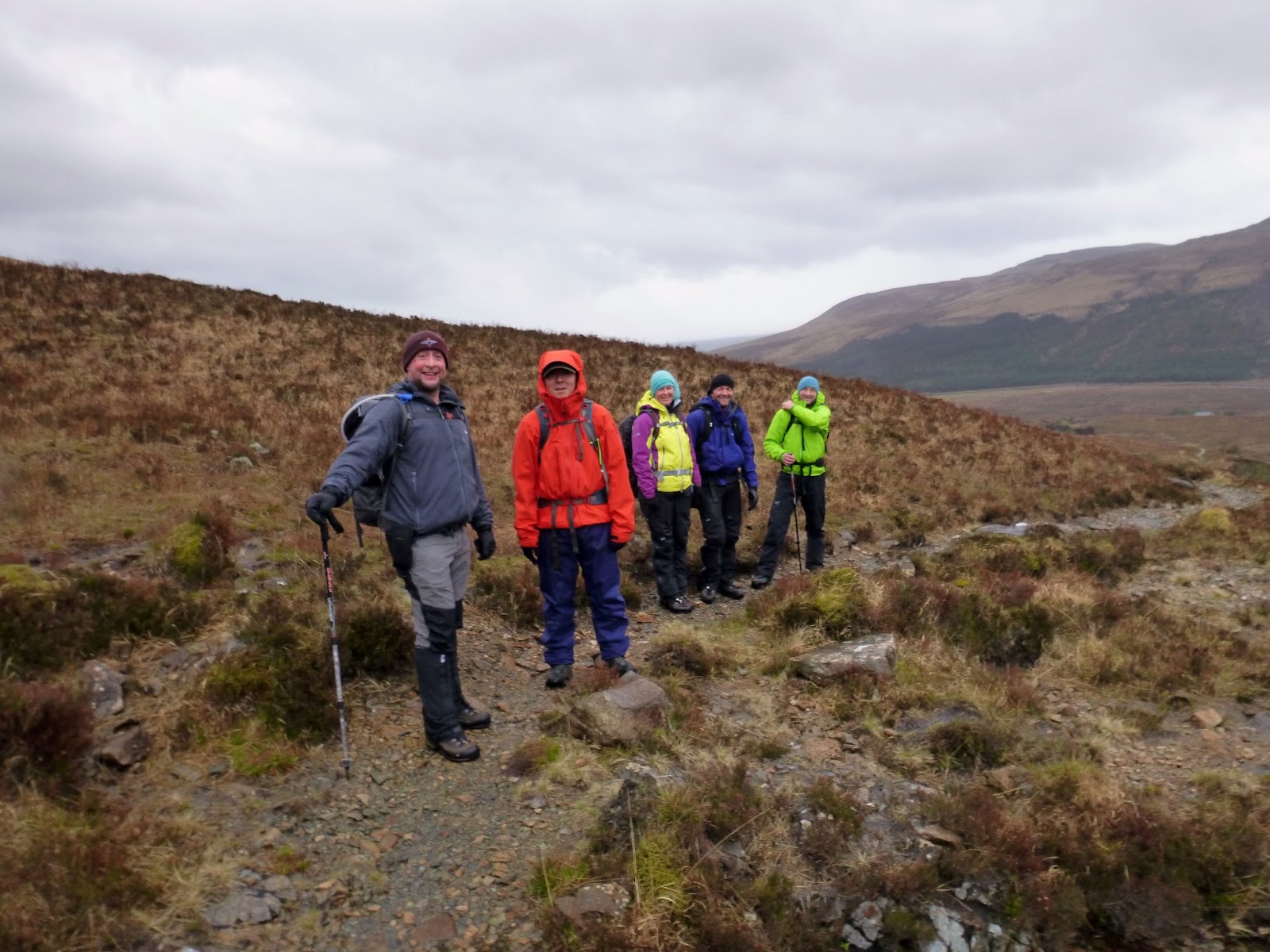
Our trip to Skye was rather tougher than usual this time. Iain arrived on Skye on a lovely sunny day only to be aware that the next day would be the complete opposite. Indeed, that evening, he told the five clients booked on this trip that Sunday would be a day off as the forecast was lousy. However, on Monday, we did attempt to walk in to Sgurr a' Ghreadaidh and Sgurr a' Mhadaidh as the forecast was slightly better - less rain, but pretty windy still. Photo one shows the group (left to right) Mark, Andrew, Vicky, Doug and Darren on our walk in to Coire a' Ghreadaidh on Monday morning.

However, two hours later, we were heading back out of Coire a' Ghreadaidh again having made it as far as Coire An Dorus where the gusts of wind were trying their best to knock us over. The cloud never cleared the ridge although we did, at one point, get a brief view of the notch of An Dorus. It was pointless trying to get on to the ridge in such conditions and indeed, it would have been dangerous to attempt to do so.

Photo two shows the wind blowing a waterfall back uphill in Coire a' Ghreadaidh on our walk back out. We were back at the vehicles by 1pm. The members of group went off to do their own thing in the afternoon. Iain went to climb the impressive hill of Preshal Mor in Glen Talisker in the afternoon. You can read about that here - it is well worth doing on a day off!

The forecast for Tuesday, was, if anything, little different to Monday - similarly strong winds forecast and showers. Iain got up at 7am and looked out of the window at the cottage where the cloud was down to 50m above sea level and the rain was blowing horizontally past the windows. It was definitely not a ridge day! We were now on day three and from Iain's perspective, this Cuillin Ridge Traverse Trip was not going well so far!

However, the forecast for the Wednesday was looking fab; and the complete opposite to the foul weather we had experienced over the last three days. No wind, blue skies; and warm conditions.

We made the decision to rise super early and left the cottage at 6am - setting off from the Glen Brittle Memorial Hut at 06:30 with our sights set firmly on ascending the Inaccessible Pinnacle. Iain started roping the group across this - the most difficult Munro to attain in The Cuillins at 10am; and photo three is taken shortly after mid-day when had had successfully gotten the whole group up and down it. Now this was more like it!

We had deliberately gotten up so early so that we could achieve the objective of an "In Pin" traverse. Also, we needed to get some mileage in on the Cuillin Ridge to make up for the lack of progress over the previous three days.

Photo four sees the group on top of Sgurr a' Mhadaidh at around 17:30 later that day after we had traversed from Sgurr Dearg all the way to this Munro top and undertaken some of the most exhilarating scrambling the Cuillin Ridge has to offer en route. Indeed, the Sgurr a' Ghreadaidh Arete should not be undertaken in wet & windy conditions as it is a seriously exposed knife edge - but today it was fine. We arrived back at the vehicles at 19:30 - so had put in a 13 hour day to do all of this, but it was undoubtedly worth it!

Thursday was also looking to be as good as Wednesday and so once again, we got an early start; although Iain asked to make it an hour later due to the length of the previous day.

We left Glen Brittle Campsite at approximately 7:30 and by 11:30 - had reached to the top our first Munro of the day - Sgurr Nan Eag. The views all around were stunning and we could see for miles in every direction including Ben Nevis in the east and all of the outer hebrides - but not quite as far as St Kilda on this occasion! Photo five was taken looking down into Coire a' Grunndha as we made our way from Sgurr Dubh da Bheinn to Sgurr Alasdair at around 3pm.

Today was a perfect Cuillin Ridge Traverse day, still and hot - if anything, a little too hot, but we weren't going to complain about that! We cracked on along the ridge travelling over Sgurr Alasdair - the highest summit on the Cuillin Ridge and this only left us needing to get to Sgurr Mhic Choinnich to "link" to the section of ridge traversed the previous day.

However, the section from the Great Stone Chute over Sgurr Thearlaich and around via Collies (Hart's) Ledge is serious scrambling and not to be undertaken lightly. Getting to the Bealach Mhic Choinnich alone calls for the rope to be used for lowering on two serious down-climbs. However, the group were up for it and we were one member down as Vicky had decided not to join us today. Photo six sees the group on Collies Ledge at around 6pm with another hour of scrambling over Sgurr Mhic Choinnich and down to the floor of Coire Lagan before things eased off; and then, we still had over an hour's walk back to the cars.

Another long, but worthwhile day!

So that was two good days in the bag. Eight out of the eleven Munro tops gained and half of the Cuillin Ridge Traversed. However, we were now only left with one guiding day and if the group wanted to get the Munros at the northern end of the ridge, there was no way, unfortunately, that we would be able to traverse the section of ridge from Sgurr a' Mhadaidh to Bruach Na Frithe as well.

We started from the mountain Rescue post near the Sligachan Hotel on Friday morning with cloud already covering the top of the ridge and in the knowledge that the forecast deterioration in the weather was going to start earlier than we had originally expected. Iain hoped that he might just have time to get the group over the more difficult summits of Am Basteir and Sgurr Nan Gillean before the weather broke. Sadly, this was not to be the case.

By the time we reached the lower part of Coire Bhasteir, we were being buffeted by gusts coming from all directions and Doug & Vicky decided to turn around there. Two hours later, after we had given up any hope of safely attaining the summits of either Am Basteir or Sgurr Nan Gillean, we discovered that Doug & Vicky were just ahead of us as we approached the easier summit of Bruach Na Frithe (photo seven).

The final photo from this post about our May 2015 Cuillin Ridge Traverse Trip sees the group as we headed out of the lower part of Coire a' Bhasteir in the pouring rain. On a positive note, we all went on to enjoy a great evening in the Old Inn at Carbost to celebrate the achievements  of the week.

Was this Cuillin Ridge Traverse Trip a success? Well, we had three and a half days of poor weather out of six days available to the group for guiding but really made good use of the two & a half good days that we had covering sections of the ridge that are often avoided and also getting all five up and down the Inaccessible Pinnacle. Nine out of the eleven Munros available to be "bagged" were summited. So, all in all, Iain feels that reasonable success was achieved although we never guarantee a complete traverse due to the changeable nature of Skye weather conditions.

This group however, were able to get a real feel for what the Cuillin Ridge is all about - the technicality and demanding nature of the undertaking, the exhilaration and challenge of the exposure and the continuous scrambling and climbing up and down. It's hard work! We do tell you that, but undoubtedly worth it for what you will feel and what you will see on a good day; and that is a view of some of Scotland finest mountain scenery and the jewels in the ocean that are the Western Isles and Outer Hebrides.

We are hoping to run our second trip to Skye this coming September. The dates to put in your diary are Saturdays 5th - 12th and we really want to go - so get booked on! The cost is still only £450 for seven nights self catering accommodation and four days guiding on the Cuillin Ridge. After this May's trip - we already have one booking for next May from a gentleman who was grateful for Iain's assistance on the Sgurr Na Banachdich/ a' Ghreadaidh Traverse so we must be doing something right! :-)