Wednesday, 29 June 2016

Working backwards - when we can! Navigation Skills Training Weekend, June 25th & 26th 2016.

Sorry Folks. Our last Blog Post was April 29th, but we've not been out of business since - just too busy to put it all up on here! In the coming weeks, we will attempt to keep moving forward with our reporting as well as trying to work back and report on what has already gone on in May & June.

You can read about our adventures over the last two months by visiting the Kendal Mountaineering Services Facebook page and there - you'll find everything we've been up to!
Most recently, we were out last weekend with James & Christina Stevens who are on holiday in The Lake District from Hertfordshire and local lasses - Sandra & Janet from Kendal. All four had signed up to one of our Navigation Skills Training Weekends in The Lake District.

So what are these courses about? Well, the idea is to show you how to use a map to identify what  you can see around you - of course you have to make sure that you have the right map for the area first!

We make sure that you do have the right maps for the course by supplying then too you FOC as part of the course fee. All you need to bring is a compass (and we recommend the Silva Type 4 Expedition Compass as being the best one for the course), everything you would need for going out for a day into the mountains in all weather conditions; and a willingness to learn.....

Sound's pretty simple doesn't it!

And all these things were what our four turned up with last Saturday morning as we set off to venture into the fells to the north of Staveley in the southern Lake District.

We started the course by emphasizing how important it is to orientate the map (ie align it with the landscape around you) to aid identification. We discussed the various map scales on offer and their pros and cons before measuring distance on the map and then pacing it out on the ground. By the time we got int the middle of nowhere in photo three, the group could also find and give grid references and were using a compass bearing to walk in a straight line between grid references - all textbook stuff!

We spent the afternoon of day one taking more compass bearings between grid references, measuring the distance and then walking on the bearings and pacing them out. The afternoon disappeared very quickly indeed!

The next morning saw us all meet at Staveley again, but this time we drove further up the valley to begin day two of the group's Navigation Skills Training Weekend in The Lake District at a point about 2/3rds of the way up the Kentmere Valley.

The day started out sunny & quite hot (photo four). We began our day by using our compasses to identify features from our known location before setting off on our route for the day which included another short section of "hand-railing" the bye-way leading to Long Sleddale before heading off up the fell to look for something more interesting; and harder to find.
Marked on our 1:25'000 scale maps in one location on the east side of Shipman Knotts are three very small squares with a footpath leading to them.

We decided to try to locate these squares to see what they were and this meant following the rather indistinct footpath through thick bracken lower on the fell. We were able to measure our pacings per 100 metres on the first part of this path and then the group missed the route and headed off, unaware, on a different path. It took a prompting from Iain before they realised their mistake and finally headed along the right route. Eventually, we found our three squares which turned out to be 3 small walled enclosures hidden in bracken  - an ideal place for lunch (photo five).

Our final photo from this post about our most recent Navigation Skills Training Weekend in The Lake District, sees the four "hot footing it" off the hill as the forecast weather arrives (later than forecast we are pleased to say!).

After finding our three "squares", we made our way to a "ring contour" (high point) on the ridge above, which we then verified by walking on another 100 m to a wall junction (which was just where it should have been according to the map!) Then, with the wind rising  and the temperature dropping, we returned to the valley as a wall of rain moved west from Windermere towards us - fortunately not quite reaching us before we reached the Land Rover.

Christina & James and Sandra & Janet thoroughly enjoyed attending our Navigation Skills Training Weekend in The Lake District and all leave with a much better understanding or Map Reading & Navigation Skills. Our next "scheduled" Weekend Navigation Skills Training Course will be on October 8th & 9th and there are ten places available at the bargain price of £80 per person. Contact us here to book your place, We look forward to working with you!

Tuesday, 3 May 2016

Winter Mountaineering half day Sessions in The Lake District. Tarn Crag, Langdale. 29th April 2016.

Last Friday dawned looking rather ominous here in Kendal. From our home, Iain could see that the cloud was down to 300 metres on Potter Fell; and the snow that had been put down the previous day was still there to a lower level.  Also, it was raining. Not really a day for rock climbing then!

However, we had a Rock Climbing Session booked and so Iain set off to Langdale to meet Jon Calthrop. This was the view in Langdale  at 09:00!!

Jon turned up rather later than expected having experienced difficulties in getting over Kirkstone Pass (he was staying in Penrith). As Iain pointed out - today wasn't a day for a Rock Climbing Session in The Lake District, but if Jon was interested then a Winter Mountaineering (Winter Scrambling) Session was an option?? He was keen, so we got packed up & ready to go with our sights, initially on a winter ascent of Jack's Rake!

Jon had been in the area for a week on Holiday and had been out the previous day on Cam Crag in Langstrath with another Mountaineering Instructor. They would have undoubtedly encountered some snow on that route as we were also in Borrowdale that afternoon and you can see how snowy it was if you look at the post. Today in Langdale, there was noticeably more snow as we trudged up through it towards Stickle Tarn. (photo two).

For a 67 year old, Jon was going very well, but it  became apparent at around the time photo two was taken, that doing Jacks Rake was going to be a bit ambitious for a four hour (half day) session.

So, Iain offered Jon the option of doing two routes on Tarn Crag which was very much closer than Jack's Rake. In photo three, we were making our way up the easier South West Buttress of Tarn Crag - only grade 1 ground and one of our favourite locations for teaching scrambling. The good thing about this place is that there are a number of options for picking one's way up ground of different grades of difficulty - Jon was quite happy to be on the easier stuff; and also very happy to be on a rope as well!

The terrain proved to be ok on the rock which was dry and not too snowed up. The bits of grassy terrain between proved to be treacherous - wet grass overlain with wet snow meant it was very slippery indeed!

We got to the top of the lower buttress of Tarn Crag with time to do another route, so Iain suggested a winter ascent of The Spur (grade 2) - another of our favourite teaching scrambling routes.

This scramble starts at the foot of a rocky rib towards the south side of the main buttress of Tarn Crag and takes a line that weaves out right before moving back up on to the crest of the rib - finishing  up a few steep walls before arriving on the summit of Tarn Crag.

It was certainly a bit more exciting today with a covering of snow and the initial move across the exposed slab was interesting, but ok. Jon found it quite exciting though - he looks quite pleased with himself as he moves up to join Iain at the stance at the top of the first pitch  (photo four). That's the summit of Harrison Stickle in the background which had recently put in an appearance as the blizzard had temporarily ceased!

The second pitch of the route was much more snowed up and time was rapidly moving on, so Iain deviated  from the line of the route into an interesting gully that would soon bring us out on to an easy grassy slope from where we could escape the crag.

We descended a gully to the south which brought us out near to a ruined building on easier ground near to a footpath which descended to join the main route between the valley floor and Stickle Tarn (photo five).

The ground was extremely slippery with its covering of wet snow; and despite his Scarpa Mantas, Jon was struggling to keep his footing so, Iain kept him on the rope all the way to the main path; and a good idea it was too!

We got back to the vehicles at 13:45 and Jon was very grateful for what he reckoned, had been a much better session than he had experienced the previous day - that was nice to hear!

The session had been much more challenging than that originally planned - Rock Climbing to Winter Mountaineering, but Iain had looked after Jon well and pitched the session at just the right level for him. As an experienced Mountaineering Instructor, Iain will always attempt to give you the best possible experience regardless of the conditions; and exceed your expectations every time!

We'd like to think that's it for Winter now - but who knows! However, if you are looking for a Rock Climbing Course or Scrambling Course in The Lake District, Wales or Scotland then contact Iain here. We look forward to working with you!

Monday, 2 May 2016

Ghyll Scrambling in The Lake District. Thursday 28th April 2016.

Well, last Thursday, Iain was out  in Hause Gill at Seatoller running the Team Building Session for the second intake of Nucleargraduates Cohort Ten.

As usual, the group turned up full of enthusiasm which is not unusual for a group of undergraduates who have been successful in gaining apprentice-ships with the UK's leading recruitment agency for jobs within the Nuclear Industry.

They had an idea of what they were letting themselves in for on this Ghyll Scrambling Session in The Lake District, but even Iain was surprised at how it would ultimately turn out!

Last week, an Arctic airstream returned to The Lake District. We were experiencing temperatures more akin to February & March weather - less than ten degrees Centigrade during the day and minus figures at night. During the day, sunny spells & showers -wintry showers, were the order of things. Not really the sort of weather for getting immersed in a freezing cold mountain stream, but this group's session was booked & paid for and the client were expecting us to run it!

Nucleargraduates recruit around 30 to 40 new apprentices a year; and since 2011, when they first came to us looking for an activity to promote Team  Building between new recruits, we have run some 24 Ghyll Scrambling Sessions in The Lake District for them; and two large Corporate Team Building Events. The association continues to be a happy and fruitful one because Ghyll Scrambling (also known as Gorge Walking) can be used to get a group of strangers working together; and forming bonds as we have proven time and again!

Firstly, it is essential to get the group equipped correctly for their Ghyll Scrambling Session; and today was going to be difficult with snow settling in Borrowdale to the 300 metre mark. So, neoprene was provided for bodies, feet and hands! In addition, we also provide proper walking boots  for good ankle support grip & protection, fleece tops if needed and a waterproof pullover (cagoule) to aid insulation plus a helmet to protect heads. Harnesses are also essential where climbs need to be protected with use of a rope.

The young chap in photo three was wearing everything we could possibly give him to keep him warm;and despite the fact that the temperature had now fallen to zero degrees, everyone was warm enough.

This allowed them to focus on the task; and that was to get to know each other through working together to make progress up the ghyll in what was a truly hostile environment today.  They worked well as a team, enjoyed a lot of laughs and definitely got to know each other much better!

What happened to day will be remembered by them for a long time; and would no doubt be the subject of much discussion that evening around the dining table of a Keswick Restaurant.

This Ghyll Scrambling Session in The Lake District will be remembered by us too as the chilliest we have ever run!

We didn't get as far up the ghyll as the first group did in early April - when it was actually a little warmer, but this group worked hard and stuck at it; and that was what counted!

Once out of the ghyll, we quickly made our way back to the car park to get changed and then we provided a hot drink to everyone  to warm them up before they headed back to Keswick.

We would like to congratulate the group on their efforts during this pretty tough session and wish them all the best with their apprentice-ships within the Nuclear industry. It is clear that they will all do very well!

Our corporate client paid just £40 each for the apprentices attending this Ghyll Scrambling Session and all of the equipment they were wearing was provided as part of the fee.  If conditions are chilly then we always provide a hot drink at the end of the session.

Ghyll Scrambling or Gorge Walking as it is also known is great for Team Building, Stag & Hen Events or a group of friends or families looking for a fun & exhilarating activity to try.  We wouldn't usually suggest that you try it in winter, but in Summer it is truly great fun!

Rumour has it that the heatwave is about to happen - so contact us here to book your Ghyll Scrambling Session in The Lake District. We look forward to working with you!

Monday, 11 April 2016

Guided Rock Climbing Sessions in The Lake District. Sunday 10th April 2016

Yesterday, Iain was out in the afternoon sun - rock climbing in Langdale with  returning clients Andy Craggs and his mate Sean.

We first worked with this pair along with their mate Phil whose birthday it was on that occasion during last October. Then, we organised an introductory Rock Climbing Session for the three followed by an afternoon kayaking session on Coniston Water.

These guys are all long standing mates - having grown up in the same street together and they still get together now on regular occasions. Rock climbing wasn't really Phil's gambit, but Andy & Sean had enjoyed their previous session with Iain and wanted to try something more challenging.

So, Iain organised a half day of guided multi-pitch rock climbing for the pair. On photo one, we are about to start up the first pitch of Route 1 on Upper Scout Crag.

We were lucky here today. The previous evening, it had been snowing even in Kendal and Iain was sure that climbing would be a chilly prospect, but the day was cloudless and the sun melted the snow and warmed the rock and there was only the slightest of breeze. By early afternoon conditions were great for rock climbing, but where were all the climbers?

We had Route 1 to ourselves for most of the afternoon. After getting the lads tied on, Iain set off up the first pitch to the first stance, set up a belay and brought Sean and  Andy up to join him.

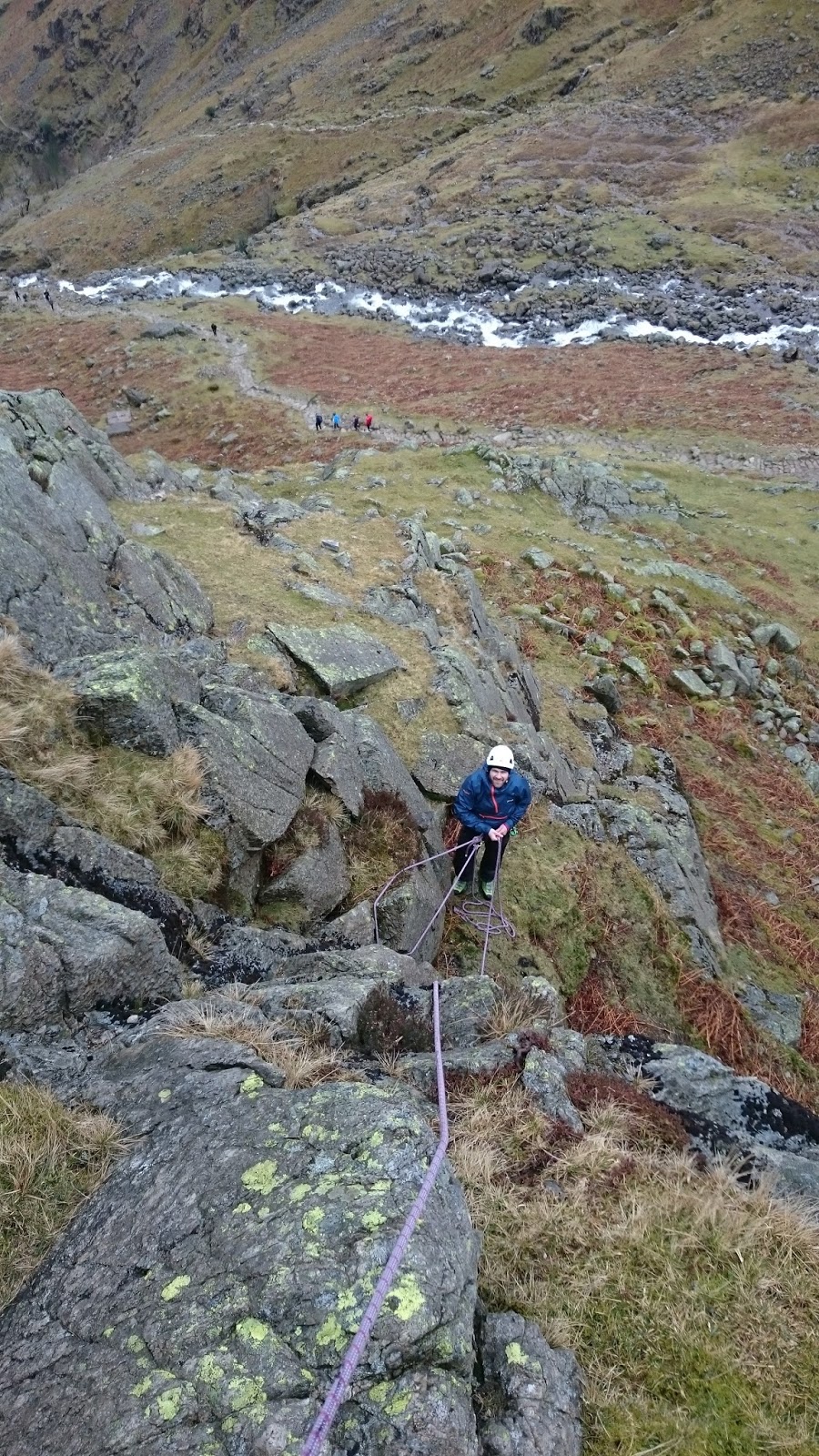
We had spent a bit of time before stating discussing how to remove anchors and deal with running belays and slings. It all went fine until Andy got to the last runner just below our stance and couldn't extract it, so Iain had to descend to retrieve it. There he snapped Photo two looking up at Andy & Phil securely attached at the top of the first pitch.

Photo three sees Sean & Andy arriving at the top of Route 1.

This fine little multi-pitch rock climb has three pitches, with good stances inbetween and lots of good anchor placements. The route is graded V Diff (Very Difficult) but in  terms of rock climbing grades V Diff lies almost at the easy end of the spectrum. There are a few interesting bits on the route- the rather smooth slab on the first pitch; and the arete (the hardest part - also known as the Crux) on the second pitch. After that, the third pitch is really, an easy scramble to the top of the route.

The route was enough to get the lads "juices flowing" though, with the exposure & challenge just right to keep them talking about it!

Photo four is a snap from  the top of the crag and one that Iain can't resist taking time & time again - particularly on such a lovely day.

There are many beautiful places in the world and many are more beautiful than here (try Patagonia!) but on a nice day, the Lake District is hard to beat with its rugged mountains,  beautiful wooded valleys and pretty lakes. The area also abounds with rock faces, there is rock climbing to be found in every valley and there area is steeped in climbing history.
In a half day (four hour) session, any Mountaineering Instructor would do well to guide two clients up a couple of multi-pitch rock climbs and Iain is no exception. How fast you get up a route depends on the conditions, the confidence of the climbers and how well they have absorbed the information given to help them follow you up a rock climb.

Sean and Andy had climbed Route 1 with confidence; and we put this climb behind us in three hours giving us time to get part way up another rock climb - Route 2 before abseiling down to the foot of the cliff as in an "abseil retreat".

Iain wanted the lads to experience the different way in which you abseil from a multi-pitch rock climb where you actually control your own descent using a belay device. Last time they had climbed with Iain,  they were merely lowered back down the route by their belayer as part of their introductory rock climbing session. Today's method was very different!

This time, having climbed up to the second stance on Route 2, they were actually going to have to untie from the climbing rope, but first, we all had to secure ourselves to something else for safety.

At the top of pitch two on Route 2 sits a conveniently sited Oak tree around which Iain attached a sling and then he got Sean & Andy to attach to this sling each with another sling larksfooted through their harnesses.  In the middle of each sling an overhand knot was tied and once they had done this and clipped into the anchor sling, it was then safe to untie from the ends of the rope.

Iain threaded the rope around the Oak tree until he reached the mid point of the rope and then threw both ends down to the foot of the crag. We all attached our belay devices into the slings between the harnesses and the overhand knot and attached them to the climbing rope. We could now disconnect from the anchor and remove it. Photo five shows the arrangement for each of us at this point.

It was now simply a case of abseiling down one after the other. Iain went first and coached Andy down  whilst protecting him by holding the trailing (dead) rope in case he let go.

Andy then did the same for Sean (photo six). Once both were down, that was the end of their Guided Rock Climbing half day Session in The Lake District.

You can experience Rock Climbing in The Lake District with us for just £45 per person for a half day (four hour) Introductory Rock Climbing Session (minimum of two persons). We'd recommend doing that before trying what these two did with Iain yesterday,  Rock Climbing is challenging, but fun and safe when the sessions are run by one of our qualified & experienced Mountaineering Instructors. Rock climbing is ideal for families with children, groups of friends, people attending a Stag or Hen Event or corporate groups looking for a team building session.

Contact us here to book your session now, We look forward to working with you!

Sunday, 10 April 2016

Lake District Ghyll Scrambling Sessions. Borrowdale. 7th April 2016.

A couple of days after running a great Scrambling Skills Training Course for Owen Higgs, We have been out again, in a completely different location, doing something completely different with a group of nine young people.

Pictured in photo one, this group is the first intake of Nucleargraduates Cohort Ten. We have been fortunate to have remained associated to Nucleargraduates since they came to us in 2011 looking for a group activity that would help to bond people together.
Ghyll Scrambling is great fun for everyone not just apprentices such as these. You get equipped with a wet-suit to keep you warm as well as a cagoule to provide additional upper body insulation, walking boots to provide protection for your feet and good grip. A helmet for your head and a harness where it is likely you'll be roped up a waterfall. For ghylls with deep pools you'll also be provided with a buoyancy aid to keep you afloat.

With all of this equipment you'll be well prepared to enjoy the exhilarating experience that is ghyll scrambling in The Lake District.

So what is the sport of Ghyll Scrambling?  Well as you can see, you actually get into a mountain stream or Ghyll and walk up it - scrambling up small waterfalls and climbing up others whilst protected by one of our instructors. You'll also be wading or swimming through pools working upstream against the flow of the stream which can be quite strong, it is an exciting and challenging experience but great fun.

Ghyll Scrambling is ideal for everyone form children to adults and at only £45 per person for a four hour session (less the larger your group size) it is something that everyone should try at least once in their lives. Definitely add this activity to your bucket list and do it with us here in The Lake District!

Just look at the fun this group are having in photo three climbing up the side of this waterfall!
So why do Nucleargraduates use us to provide this activity for them. Well, here, Ghyll Scrambling is used in the context of "team building" or as an "ice breaker".

Why? These young  graduates, all with degrees in engineering or Nuclear Chemistry have been successful in gaining a two year  apprenticeship within the Nuclear Industry and will, at some point during those two years, be working alongside each other. They came together for the first time the previous day and this activity is designed to get them working together and building bonds and friendships that will last them through their apprenticeships within Nucleargraduates and beyond.

We have proven that used in this context - it works!

Whether or not  you are  a business, a family, a group of friends, or someone looking for a suitable activity as part of a Stag or Hen Event, you should try Ghyll Scrambling (also known as Gorge Walking) with us.

It's an experience you'll never forget, so contact us to book your session. We look forward to working with you!

Lake District Scrambling Courses. 5th & 6th April 2016.

After his weekend on the Kentmere Fells running a Navigation Skills Training Course for Richard, Andy & Joe, Iain was back out the next day to meet Owen Higgs in Langdale for his Scrambling Skills Training Course.

Owen had originally booked this course almost two years ago and was to have attended with a friend who had a tragic accident just a few days beforehand. Owen asked Iain if he could postpone until another time? Absolutely no problem - what else  could anyone have possibly  said!

Anyway, Owen got in touch early in the New Year to reschedule his scrambling course for April and we were happy to oblige.

Photo one sees Owen at Tarn Crag in Langdale where we spent the first day of his training course. We started off looking at "spotting" where scramblers help each other using hands and a braced stance to ascend an easy scramble where use of a rope is unnecessary and would only slow things down.

Photo two sees Owen getting to grips with short roping techniques.

Short roping is used on ground where a slip could turn into something more serious, but where the ground is a mixture of easy & harder terrain - in most likelihood a grade II buttress with steps of no more than a metre or two requiring a tensioned rope to stop a less capable second from slipping.

Most of the rope is not required so therefore the lead scrambler takes chest coils and then locks these off to prevent getting throttled if the second falls. The leader will have a reservoir of coils in their uphill hand that should be of sufficient length to allow the leader to ascend any easy pitch whilst leaving the second stood still in a safe place. The leader will always be above the second acting as an anchor at all times and using a braced stance to prevent them from being dislodged (pulled) over and that is also the reason that Owen is holding the rope with a bent arm - to prevent being pulled over!
Sometimes however, scrambling ground can get so serious that merely short roping and belaying someone with your body & hands will not be sufficient to safeguard either them or you; and it is important that safety comes first at all times when scrambling. This is when using direct belays comes into place.

In photo three, Owen is using a direct belay to lower Iain down a steeper part of a gully where he would have trouble holding Iain otherwise were he to slip. In this case, the direct belay is merely a spike of rock around which the rope is run and the friction of rope against rock is sufficient to provide a safeguard.  This sort of belay can be used in ascent as well as descent and is a very quick means of providing a safeguard. However, it is essential that any such rocky protuberance is checked thoroughly to ensure that it is a solid part of the surrounding rock  and not likely to break off in use - with potentially fatal consequences!
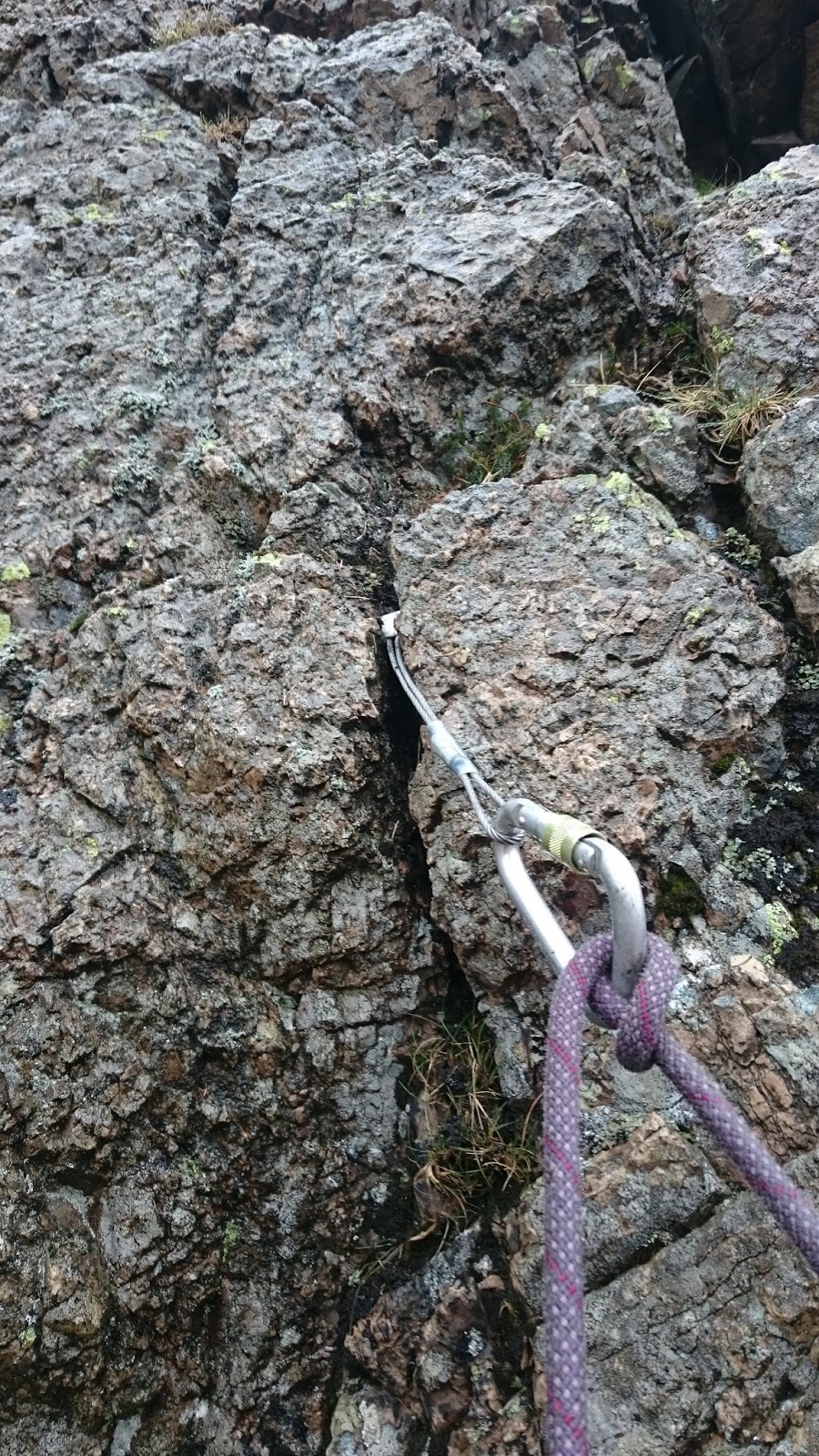
As well as looking at spotting, Short Roping and Direct belays using rope over rock, we also looked at pacing artificial anchors such as this one in photo four.

The metal wedge on a swage of metal wire is known by a number of terms - "wires", "nuts", all are branded products such as DMM''s Wallnuts or Wild Country's Rocks for example; and they come in a range of sizes. For placements where nuts or wires are too small, one can use chocks such as Hexcentrics or Torque Nuts.

All of these anchors have one thing in common - they are designed to be inserted into tapered cracks where they will only jam in tighter  if they receive a shock-load.

Iain gave Owen the chance to insert these into appropriate cracks  and then use them as a direct belay by attaching an HMS (pear shaped) karabiner used in conjunction with a rolling hitch (Italian hitch) to safeguard someone up or down serious ground. You can use a tape (Dyneema) sling around a rock spike in conjunction with the same karabiner/rolling hitch combination as well.

By the time we had covered all of these techniques with Iain demonstrating and then allowing Owen to practice, the day was almost over. We had had a later than planned start after Owen had turned up thinking that a pair of approach shoes would be appropriate for the day, but Iain persuaded him to get the best footwear for the job; and we nipped back into Ambleside so that he could purchase a pair. It was just as well we did, as not long into our Scrambling Skills Training Course, the rain started  and didn't let up for the rest of the day. Owen was glad that Iain had persuaded him to buy something appropriate for the task in hand, otherwise, it is likely that his first day would have had to be cut very short!

Day two found us back at Tarn Crag in the morning (photo five) where  Iain guided Owen up his first grade II Scramble.

This was done in order that Owen could get to see the different the different belaying techniques that Iain would use where appropriate to safeguard him on such a scrambling route.

The intention had been that Iain  would guide Owen up this route and then that we would return to put Owen on the "sharp end" so that he could try the techniques for himself and have his application of these appraised by Iain.

However, that morning was also pretty vile - cold and wet making the Lake District  rock very slippery indeed and forcing Iain to employ rock climbing tactics at one point - beyond the level at which he was teaching Owen today. It was decided to change plan, with Iain guiding Owen for the rest of the day - something that Owen was quite ok with!!

So, having finished the Spur (grade II) on Tarn Crag and having then had some lunch, we headed up over the summit and around Stickle Tarn to scramble up Jack's Rake (the diagonal ramp  ascending the cliff behind Owen in photo six) on Pavey Ark .

Jacks Rake is one of The Lake Districts  most popular scrambling routes and only graded I.  For this reason it gets a lot of ascents by people who think it is merely a steep walk up the cliff. That - it most certainly is not!

The first part of this route follows a seemingly friendly gully which gets steeper as you climb until it peters out forcing you to climb an exposed, polished & often wet groove to get to the Rowan tree at its top. Many people neither equipped to; nor experienced in dealing with such terrain have found themselves "in extremis" here and the place has been the scene of a number of fatalities in recent years. Above this point, the ramp angle eases and apart from one other serious step above the junction with Crescent Climb; and some easier steps towards the exit pinnacle, this is a most pleasant and rewarding scramble.

And today it was a most rewarding route to be on. The nature of the scramble, the feeling of exposure and the  views that opened out as we climbed higher & higher made it feel like the special place that it truly is.

An improvement in the weather only added to our feeling of exhilaration and it was with a great feeling of satisfaction that we arrived at the pinnacle (right  of Owen in photo seven), unroped and enjoyed some more lunch. What a fantastic route!

We were finished on Jack's Rake a little after 2 pm, so there was still time to fit in another scrambling route and Iain decided that we should take a look at the nearby "Pavey Far East". This is another grade II scrambling route listed in the Cicerone guide Lake District Scrambles South also on Pavey Ark.

Iain had been here once before with a pair on a  scrambling Skills Training Course who decided that they wanted to give up at the first buttress - they must have had a premonition!

We continued beyond the first buttress following a line above a cliff. The line wasn't great as it traversed along sloping rock and grass and it was difficult to provide any protection for Owen at the best of times and although he was quite happy - Iain wasn't! When our route took us down an unprotectable groove with a large drop beyond, Iain decided enough was enough, so we bailed off the route and scrambled up to better ground (photo eight) Neither of us felt it was any great loss! This route is one for bone dry weather only! Iain's view is that Brian Evans must have been getting desperate for something to fill the final pages of the guide when he picked this line.

That was the end of Owen's 2 day Scrambling Skills Training Course in The Lake District and he was absolutely delighted with what we had achieved. He plans to return, hopefully in June with his daughters for whom he had come on this course in order that he could take them scrambling in the hills. We look forward to working with him again then.

Owen paid just  £160 per day for his Scrambling Skills Training Course in The Lake District with Iain and that price is for one or two persons. Helmets & harnesses are provided as well as enthusiastic instruction and coaching from an experienced Mountaineering Instructor. If you would like to learn scrambling Skills for yourself, then contact us - we look forward to working with you!

Navigation Skills Training Weekends in The Lake District. Saturday & Sunday 3rd & 4th April 2016.

Last weekend saw Iain running a Navigation Skills Training Course in The Lake District for Richard McEvoy and his friends Andy & Joe.

All come from the Keighley Area of West Yorkshire where they spend their spare time running bush-craft courses for a local young persons club. The three wished to learn Navigation Skills Training in order to increase the breadth of what they can offer the club by possibly taking the lads hill walking.

Due to the weather, we changed from the original plan of meeting at Staveley to go to the Kentmere Valley and instead met in Kendal to go into Longsleddale.

Photo one sees us climbing out of Longsleddale on what was  a very wet start to their Navigation Skills Training Weekend!
As usual with our courses, we started off by discussion the differences between the two map scales we would be using and then outlining the important of orientating the map. We then measured distance on the map and learnt how to pace out 100 metres on the ground.

After this, we set out on our days journey which would take us up on to the area of fell between the Longsleddale & Kentmere Valleys measuring distance and pacing between "tick off features". As our route was quite steep up out of the valley, we were able to compare our pacings per 100 metres on different slope angles which was most useful.

After an our of doing this, we found ourselves at the top of the slope above Longsleddale and it was time to move on to the next stage of the lads Navigation Training ie learning about grid references  - except we were stuck out in the cold and rain. Fortunately, Iain knows of a bothy which contains benches and a table and here we were able to get under cover, sit down and have a classroom type lesson about grid references  and taking compass bearings (photo two).

Really, it was just as well were were able to get under cover for that part of the course as outside, the weather had, if anything, gotten worse.  We spent the rest of the day "bog hopping" and looking for features such as stream junctions (photo three), pools of water, ruins and bridges as well as identifying some contour features along the way.

The lads picked up the Navigation skills provided by Iain very well despite the weather, good stuff!

Photo four was taken at almost the same place as the first photo of this Navigation Skills Training Course as we made our way back down to the vehicles at around 4pm.

As you can see, the weather was starting to dry up as was forecast,  however, the whole area  had received a thorough soaking as had we. The original plan had been to wild camp at the head of the Kentmere Valley, but by coming to Longsleddale, we had given ourselves another option for our overnight stay in the mountains.

Photo five sees Andy & Joe loaded up in the back of Iain's Land Rover after we had all driven up Longsleddale as far as you can go in a car.

What lay ahead of us now was a three mile drive up a challenging bridleway to a point high up where we would been able to walk a short distance to a peaceful & secluded wild camping area; or, if things were too wet, have the option to "overnight" in one of the Lake District's few bothies. We had already decided to take the bothy option!

Photo six sees us all outside of the bothy the next morning after a good, dry, night's sleep.

The  walk here from the Land Rover had taken about an hour and after we had settled in and eaten, we went out to do some night navigation.

"Night Nav" is difficult and relies solely on an individuals ability to accurately pace and walk on a bearing as well as "time" how long each leg between grid references will take. Richard, Andy & Joe performed well throughout the session and it was almost midnight before we arrived back at the bothy. No-one was particularly keen to get going early the next morning and it was after 10am before we left this place.

We headed straight up the slope to the north through the nearby quarries to find a summit, pacing, timing and walking on a bearing to get us there.

The weather on day two of this Navigation Skills Training Course in The Lake District was bright and sunny - but consequently, a lot colder! We continued west on to the summit of Branstree (photo seven) passing some large snow patches along the way. Everyone was surprised by the amount of snow lingering on the fells, but prior to Easter, the weather had been dry & bright for weeks  and it would have been cold up here with frosts every night.

We descended west from Branstree to Gatesgarth Pass (photo eight) and then made our way down to  Brownhowe Bottom (in the middle distance) where the Land Rover was parked. Richard had asked to be back there by 2 pm so that the lads could get a good  start on their way back home as all were back at work the next day. Iain would be too!

Richard, Andy & Joe each paid £120 for this two day Navigation Skills Training  Weekend in The Lake District with a qualified & experienced practitioner who had the forethought to build some flexibility into the programme due to the weather forecast. You can join one of our Weekend Navigation Skills Training Courses for just £80 for the two days. 

The next one of these courses is running two weeks time during April 23rd & 24th. Our Navigation Skills Training Courses in The Lake District will give you the skills you need to head into the mountains in unfamiliar terrain with confidence and are ideal for anyone preparing for a Mountain Walking Leader Assessment as a Navigation Refresher Course. Contact Iain here to book your place. We look forward to working with you.